
আরও দেখুন


 11.02.2026 08:45 AM
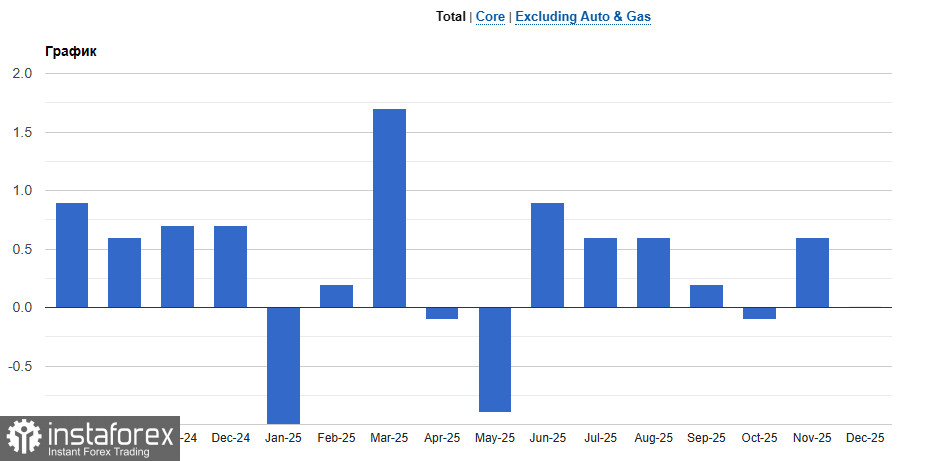
Yesterday, the US dollar fell after reports that US retail sales unexpectedly stalled in December 2025, signaling a decline in the role of consumers in the economy at year-end. This indicator, one of the key gauges of consumer activity, showed a marked slowdown and missed economists' expectations.

The disappointing data suggests that the early seasonal surge in pre-holiday shopping proved short-lived. Households remain squeezed by high living costs and are concerned about labor market conditions. Elevated inflation continues to erode purchasing power, and uncertainty about jobs is prompting consumers to be more cautious in spending, prioritizing essentials.
That dynamic calls into question the sustainability of US growth and could influence future Federal Reserve decisions on interest rates. A weakening in consumer demand may signal a need for looser monetary policy to support the economy. As a result, investors have begun to revise their expectations, which contributed to the dollar's decline in currency markets.
According to the Commerce Department data released on Tuesday, nominal retail purchases were essentially unchanged after a 0.6% rise in November. Excluding auto dealers and gasoline stations, sales also remained flat.
Sales fell in eight of thirteen retail categories, including clothing stores and furniture outlets. Auto dealership sales also declined. Spending rose, however, at builders' merchants and sporting goods stores. The breadth of weakness across consumer categories is a concern. While equity gains may support spending among wealthier households, discretionary outlays appear weaker for lower-income Americans, who depend mainly on modest wage growth.
Meanwhile, severe winter weather late in the month, which curtailed economic activity over large parts of the United States, will complicate economists' and policymakers' efforts to assess underlying household demand at the start of the year. Industry data shows vehicle sales in January fell to the lowest year-on-year rate in almost three years, and air travel suffered major disruptions.
Many economists nevertheless believe that the softer-than-expected December retail figures will not derail fourth-quarter results. A number of experts are confident that tax refunds will support demand at the start of this year.
A technical outlook for EUR/USD suggests that buyers should consider reclaiming 1.1925. That would open the way to test 1.1957. From there, a move to 1.1994 is possible, although advancing beyond that without support from major players would be difficult. The extended target is 1.2037. On a decline, meaningful buying interest is likely near 1.1890. If buyers do not appear there, it would be prudent to wait for a new low at 1.1858 or to open long positions from 1.1832.
As for GBP/USD, buyers need to capture the nearest resistance at 1.3698. Only that will allow them to target 1.3730, above which a breakout would be challenging. The extended target is around 1.3757. If the pair falls, bears will try to seize control at 1.3660. If they succeed, a break of that range would deal a serious blow to bullish positions and could push GBP/USD down to 1.3625 with scope to extend to 1.3585.


