
Veja também


 03.09.2026 12:42 AM
Yields on 10- and 20-year U.S. government bonds continue to rise despite the Treasury Department's best efforts. Briefly, why did this happen and what risks does it pose for the U.S. economy and budget?
Opinions vary among analysts, but I believe Donald Trump's policies, especially on the international front, have prompted many foreign investors to shy away from U.S. securities. Demand for these bonds has fallen sharply, so yields have risen to attract new buyers. Demand remains low, so yields keep climbing.
Why is that dangerous? Higher yields increase U.S. government interest payments. In simple terms, the U.S. government must borrow at ever-higher rates, which adds pressure on the budget and raises overall public debt. Last week, U.S. national debt exceeded $40 trillion. Annual interest payments on the debt passed $1 trillion. It is obvious: the higher yields climb, the larger future interest bills will be — and we are talking about high interest costs that may need to be serviced for decades.
It is also easy to infer that total U.S. debt will continue to rise. I don't know whether this will lead to default, but the attractiveness of the U.S. economy for foreign investors is declining. As the appeal of the U.S. economy falls, so does the appeal of the dollar. That is another reason I would currently expect the dollar to weaken rather than strengthen. Yet the market is now fixated on the Federal Reserve's September meeting and seems convinced the Fed will raise the policy rate. That view supports demand for U.S. currency and has forced revisions to the wave counts for EUR/USD and GBP/USD. Now both pairs could fall several hundred pips further — but, in my view, such a move should be backed by substantial news flow. Personally, I don't think the dollar currently has that kind of news support.
It currently has two potential positives: possible escalation in the Middle East and a possible Fed decision to raise interest rates. Neither event is certain to occur. Therefore, I prefer to avoid new downward waves that contradict virtually everything else right now.
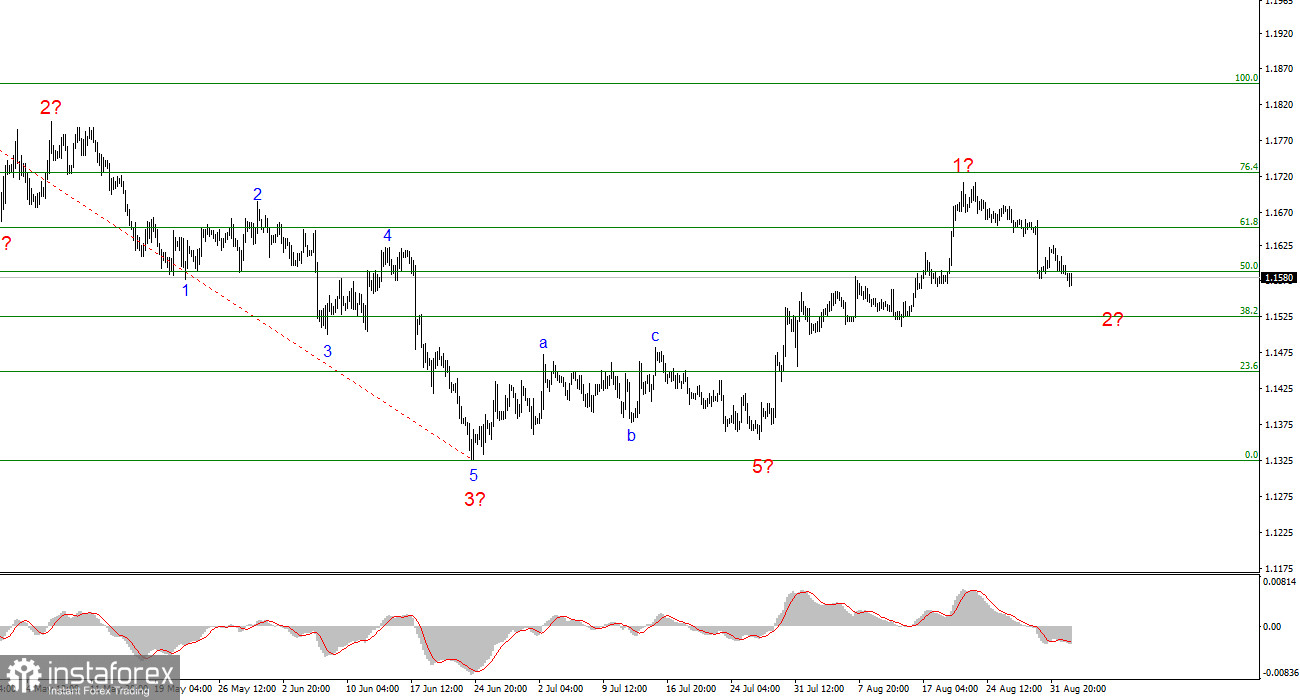
Based on my EUR/USD analysis, I conclude the instrument remains within a corrective downward segment of the trend. That segment is taking on an increasingly complex shape. It appears this segment may form an A–B–C–D–E structure. If that is indeed the case, the decline should continue toward targets below the low of wave C — 1.1325. If so, now would be a good time to build short positions, since the instrument has the potential to fall by at least 350 pips.
The wave picture for GBP/USD has become relatively clear but could still become more complex. The charts show a distinct corrective A–B–C structure that looks complete. Therefore, I expect an ensuing impulsive set of upward waves. However, the current wave labeling on EUR/USD raises doubts. If the euro develops a five-wave downward structure, then GBP/USD could also fall toward the 1.31 area. In that case, the pound's wave count would need to be revised and would take a different form and structure.


