
Veja também


 17.02.2026 06:56 PM
The EUR/USD pair has been declining for the sixth consecutive day. Once again, we are seeing a very gradual drop in the euro, as if the market is not truly eager to sell the euro and buy the dollar, yet something—or someone—is forcing it to do so. What is that "something" or who is that "someone"? In my view, any dollar strength is short-term. At present, the market does not see sufficient grounds for a new wave of U.S. dollar selling, so the dollar is strengthening gradually. Against the backdrop of slowing inflation, the ECB may cut interest rates, and this is the only more or less logical reason for the pair's decline.
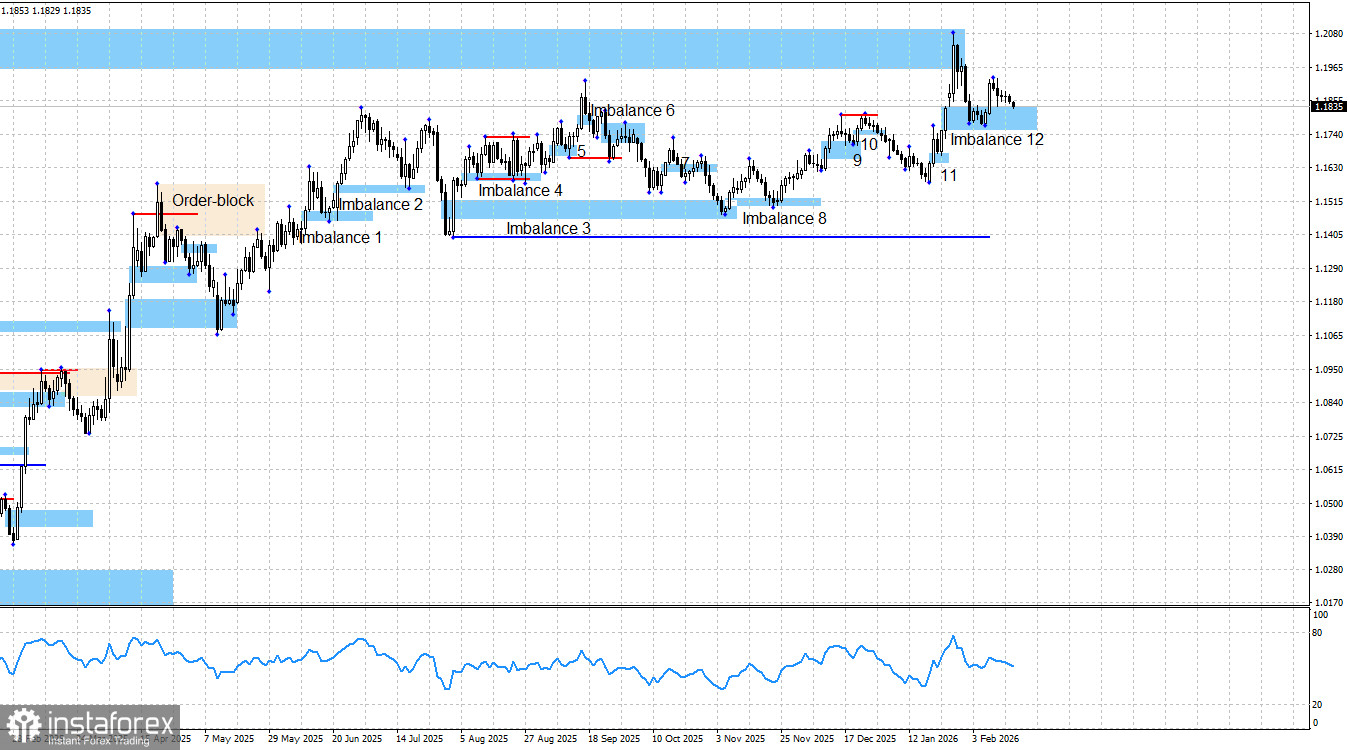
On the daily chart, it is clearly visible that nearly every rally over the past 12–13 months has been stronger and sharper than any decline. For example, between December 24 and January 16, the dollar rose by about 200 points. However, between January 19 and January 27, it fell by 450 points. Thus, first, bullish imbalance 12 has not been invalidated. Second, another bullish imbalance from February 9 can be identified, which also remains valid. Third, there are still no bearish patterns. Fourth, the news background provides rather questionable support for the dollar.
The chart structure continues to signal bullish dominance. The bullish trend remains intact. A bullish signal was formed in imbalance 11, and later another bullish signal appeared in imbalance 12. Therefore, traders may keep long positions open until the current patterns are invalidated or bearish signals emerge. Even in that case, I would not expect significant U.S. dollar strength.
The news background has neither surprised nor impressed. Inflation in Germany remained at 2.1% year-over-year, in line with the preliminary estimate. The ZEW economic expectations indices for Germany and the euro area came in lower than traders expected. Thus, Tuesday's bearish attacks were generally justified. However, in my view, the dollar may continue rising slowly—by about 10 pips per day—but eventually it will face another sharp decline.
Bulls have had sufficient reasons for a renewed offensive for the past 6–7 months, and these reasons are at least not decreasing with each passing week. These include the dovish (in any case) outlook for FOMC monetary policy, the overall policy of Donald Trump (which has not changed recently), U.S.–China tensions (where only a temporary truce has been reached), public protests in the United States under the slogan "No kings," weakness in the labor market, the autumn government shutdown (which lasted one and a half months), the February shutdown, U.S. military actions against certain countries, legal pressure on Powell, the "Greenland issue," and worsening relations with Canada and South Korea. Therefore, further growth of the pair appears fully justified in my view.
I still do not believe in a bearish trend. The news background remains very difficult to interpret in favor of the dollar, and I do not attempt to do so. The blue line marks the price level below which the bullish trend could be considered complete. Bears would need to push the pair down about 360 points to reach it, which still appears unrealistic given the current news backdrop and chart structure, where no bearish patterns are present. The nearest upward target for the euro was the bearish imbalance at 1.1976–1.2092 on the weekly chart, formed back in June 2021. This pattern has been fully filled. Above that, two levels stand out: 1.2348 and 1.2564, which correspond to two peaks on the monthly chart.
Economic Calendar
United States: – Building Permits (13:30 UTC) – Durable Goods Orders (13:30 UTC) – Housing Starts (13:30 UTC) – Industrial Production (14:15 UTC)
On February 18, the economic calendar contains four entries, two of which may be considered relatively significant. The news background could influence market sentiment on Wednesday, particularly in the second half of the day.
EUR/USD Forecast and Trading Advice
In my view, the pair remains in the process of forming a bullish trend. Although the news background favors bulls, bears have launched repeated attacks in recent months. Nevertheless, I do not see realistic reasons for the start of a bearish trend.
From imbalances 1, 2, 4, 5, 3, 8, and 9, traders had opportunities to buy the euro. In all cases, we observed some growth, and the bullish trend remains intact. A new bullish signal was later formed from imbalance 11, allowing traders to buy with a target of 1.1976, which was reached. Last week, another bullish signal formed in imbalance 12, giving traders another opportunity to open long positions. The formal targets are 1.2348 and 1.2564. This signal has not been invalidated.


