
See also


 07.09.2026 01:50 PM
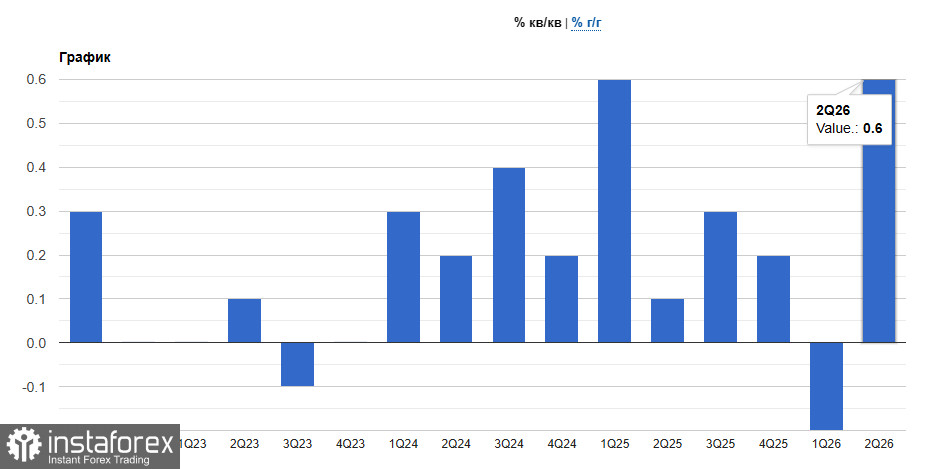
Eurozone GDP rose by 0.6% quarter-on-quarter in Q2 and by 1.2% year-on-year. The headline that most investors will seize on is the comparison with the United States: American GDP grew by 0.4% in the same quarter (after 0.5% in Q1), so the euro area outpaced the US on a quarterly basis. That's uncommon and at first glance looks like a reversal of Europe's long underperformance.

However, the component breakdown changes the story. Net exports contributed a hefty 0.9 percentage points to eurozone growth, household consumption only 0.2 points, public spending and gross fixed capital formation were negligible, and inventories subtracted 0.5 points. In short, the entire expansion was driven by external trade, while domestic demand barely contributed.
That mix is fragile by construction. An economy growing because exports exceed imports while drawing down inventories lives off external demand and stock draws. Exporters and capital-goods manufacturers win; retail and consumer-facing services lose. Retail sales in the eurozone underlined this imbalance — down 0.6% in July, with non-food retail falling by 1.4%.
The country split introduces a further caveat that can not be ignored: Ireland posted a 10.2% quarterly jump, far outstripping every other member state. Slovenia rose by 1.8%, Lithuania expanded by 1.7%, and Austria was the only economy to contract (-0.1%). Strip out Ireland and the eurozone looks noticeably weaker than the headline suggests. Germany's data is instructive: industrial production fell by 1.1% — a surprising weakness from the bloc's largest economy that would normally be the chief beneficiary of an export boom. The divergence between broad eurozone acceleration and German contraction shows growth is uneven and concentrated on the periphery rather than anchored in the industrial core.
The labor market confirms a muted domestic recovery. Employment in the EU stands at 221.4 million and 176.4 million in the eurozone. Quarter-on-quarter employment rose by only 0.1%, and hours worked also increased just 0.1%. Growth of 0.6% with almost no job creation points to productivity gains rather than broadening employment.
For the ECB's September 10 meeting in Berlin, this data strengthens the case for an interest rate hike. The upward revision from an initially reported 0.4% to 0.6% shows that the economy can withstand tighter financial conditions — the very argument Isabel Schnabel cited when calling for further steps. I expect the ECB to move rates toward 2.5% without major dissent, since the central bank typically treats weak domestic demand as secondary to the priority of fighting inflation, which accelerated to 3.3% in August.
Technical outlook
EUR/USD: Buyers need to regain control of 1.1625 to target a test of 1.1640. From there, a push to 1.1660 is possible, though achieving that without support from major players will be difficult. On the downside, significant buyer interest is likely only around 1.1600. If bids are absent there, consider waiting for a drop to the 1.1580 low or opening long positions at 1.1560.
GBP/USD: Pound buyers should aim to overcome the immediate resistance level of 1.3545 to target 1.3575. Breaking above that will be challenging, with 1.3600 as the next extended target. On the downside, bears will try to seize control at 1.3515. If the price breaks below that level, the range breakdown would pressure bulls and could push GBP/USD toward 1.3500 and potentially 1.3480.


