
Vea también


 20.08.2026 12:43 AM
On August 16, the Japanese Cabinet Office released preliminary GDP data for the second quarter of 2026. The figures were significantly weaker than market expectations—growth was 0.3% quarter-on-quarter versus a forecast of 0.5%, and the annual rate was +1.1% (forecast 2.0%). Private consumption was virtually stagnant at zero, and capital investment unexpectedly decreased by 1.2% (quarter-on-quarter) despite expectations for a 0.5% increase. This marks the second consecutive quarter of decline, indicating ongoing uncertainty among businesses.
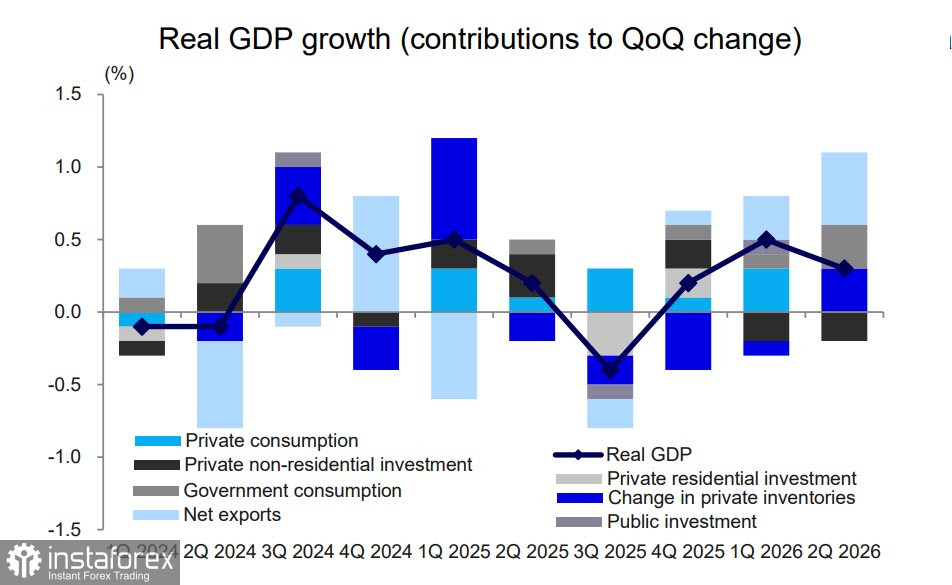
The impact of the Middle Eastern conflict and disruptions in passage through the Strait of Hormuz has already clearly been reflected in the data. Japan has significantly reduced its crude oil imports, and rising fuel and petroleum product prices have negatively affected investments and consumption.
In contrast to the gloomy GDP data, industrial production showed encouraging results, with growth of 4.9% year-on-year in June, which is significantly above the initial estimate of 4.2% year-on-year.
The market continues to assess the consequences of the joint currency intervention by the U.S. and Japan. As of August 19, USD/JPY is trading near 159.50, approaching the psychological level of 160.00, suggesting the pair has recovered nearly half of its decline.
The intervention did not alter the trend, primarily because of the enormous gap in interest rates. The Bank of Japan's rate at 1.00% remains 275 basis points below the Federal Reserve's upper rate boundary (3.75%). Even a possible 0.25% rate hike by the BOJ in September will hardly change this gap. With inflation at 1.7% (year-on-year), the real interest rate in Japan is still negative. Furthermore, the fundamental causes of the yen's weakness—Japan's structural dependence on energy imports and the significant yield gap—remain unresolved.
Weak GDP data narrow the BOJ's room for maneuver; the contradictory signals of weak growth and rising inflation now pull the BOJ committee in opposite directions.
Fundamental pressure on the yen remains. Weak GDP data limit the BOJ's ability to tighten aggressively. Analysts at Deutsche Bank warn that a 3% yield on 10-year bonds is the "key line of defense for fiscal stability" in Japan, and that breaching this level would indicate the government has lost control of the situation.
The net short position on JPY totaled -3.3 billion at the end of the reporting week, with the expected price moving lower, suggesting the bullish trend may eventually be broken.
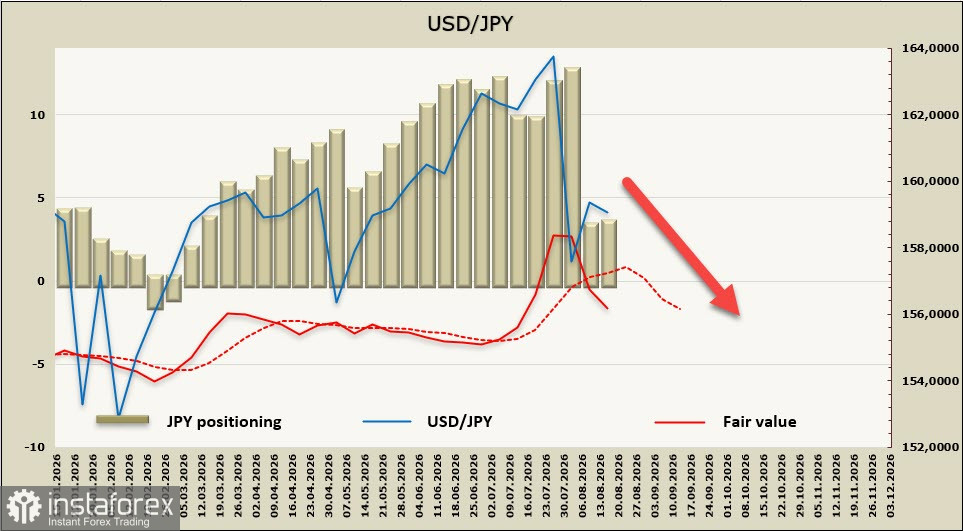
A 25-basis-point rate hike by the BOJ in September is already fully priced in by the market and is unlikely to help the yen. As the intervention merely paused the decline without reversing the trend, a possible 0.5% rate hike in December could sharply strengthen the yen. If comments emerge stating that the BOJ is considering such an option, the likelihood of USD/JPY resuming upward movement would significantly decrease. We believe resistance at 160.50/75 will hold, and the yen is likely to remain below this level, gradually drifting toward the support zone of 155.00/50.


