
Lihat juga


 03.09.2026 07:22 PM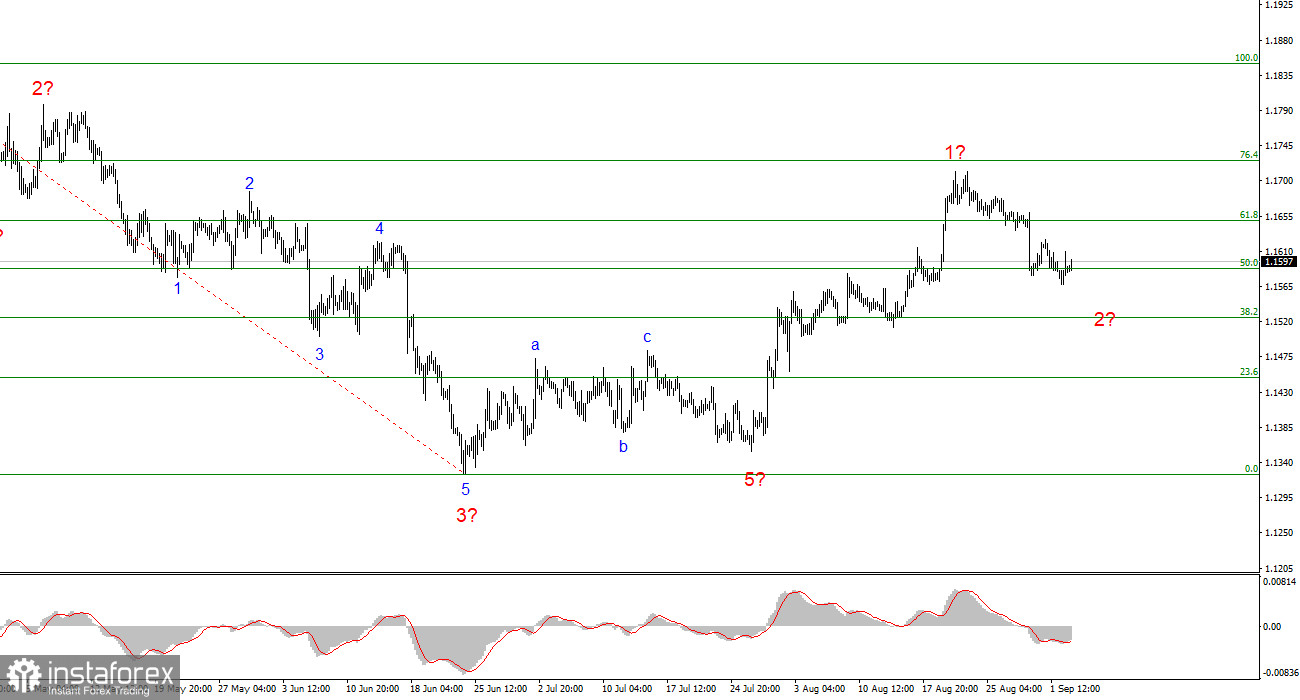
The wave count on the four-hour chart for EUR/USD is becoming more complex. There is still no question of invalidating the upward trend segment (lower chart) that began in January of last year. On the contrary, we have seen a complete A-B-C corrective structure, which has most likely been completed. We never saw a convincing wave 5 within wave C. This wave took a truncated form, which also occurs from time to time. Let me remind you that classical wave structures are generally found only in textbooks. In real-life trading, traders and analysts should be more flexible in their analysis.
Unfortunately, the wave count may become more complex again at present. Wave C may take a three-wave form, the wave that follows it will be identified as wave D, and the entire trend segment beginning on January 27 will take a five-wave corrective form A-B-C-D-E. If this assumption is correct, wave D will take a three-wave form, and on August 21, EUR/USD entered the phase of forming wave E, whose low should be below the low of wave C at 1.1325. At the same time, however, this scenario is an alternative. Based on the fundamental backdrop, I am more inclined to expect the formation of a global upward wave.
The EUR/USD pair rose by 40 basis points on Thursday, raising a new series of questions. Since the beginning of the week, at least five important and notable reports have been released in the United States and the European Union, but they triggered a completely different market reaction than might have been expected. European consumer price inflation rose to 3.3%, increasing the chances of an ECB monetary policy tightening and should have supported the euro. The U.S. manufacturing PMI fell to 54.6, which should have supported the euro. The U.S. JOLTS report on job openings came in below market expectations, which should have supported the euro. The ADP report on changes in private-sector employment came in below forecasts, which should have supported the euro. During the first three days of the week, virtually every report should have supported the euro. However, demand for the U.S. dollar increased on all three days. Not significantly, but it did increase.
Today, the United States released its services PMI, which came in above market expectations. And it caused the dollar to decline. More precisely, demand for the U.S. currency declined for most of the day, while the ISM index had no impact. Based on everything said above, what conclusion can be drawn? The market is not interested in secondary economic data and is fully focused on tomorrow's payrolls and unemployment figures, as well as Fed policy, expectations for which are changing practically every day. At present, the market once again does not believe in monetary policy tightening, so demand for the U.S. currency may continue to decline.
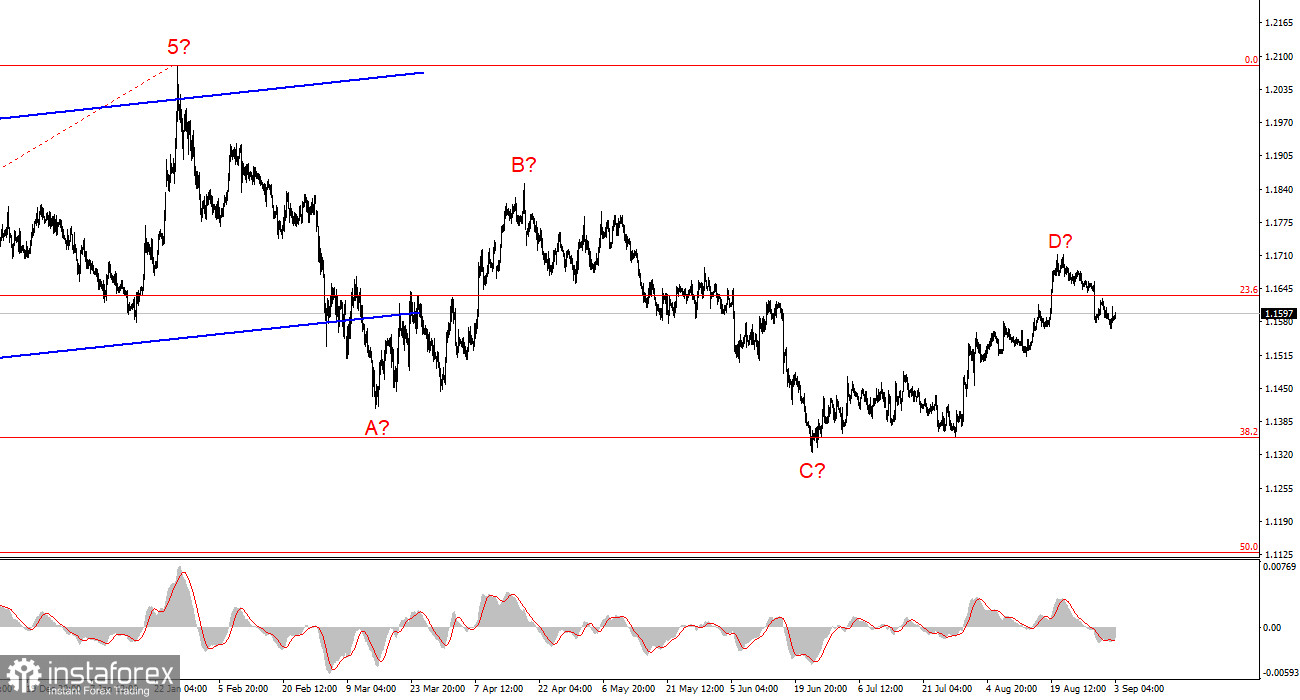
Based on my EUR/USD analysis, I conclude that the pair remains within a local upward trend segment as part of the first wave of a new global upward trend. It should be acknowledged that the trend segment beginning in January of this year may take the form of A-B-C-D-E. If this assumption is correct, the decline in prices will continue toward targets below the low of wave C at 1.1325. However, I consider this an alternative scenario. I believe that the formation of a new upward trend segment began in June, which will bring the euro back toward the 20 level.
On the higher timeframe, an upward trend segment can be seen, followed by the formation of an A-B-C corrective structure. This structure may take a five-wave form, but at present I consider it complete. If so, a new impulsive upward trend segment has begun to form.


