
Lihat juga


 21.04.2026 05:01 AM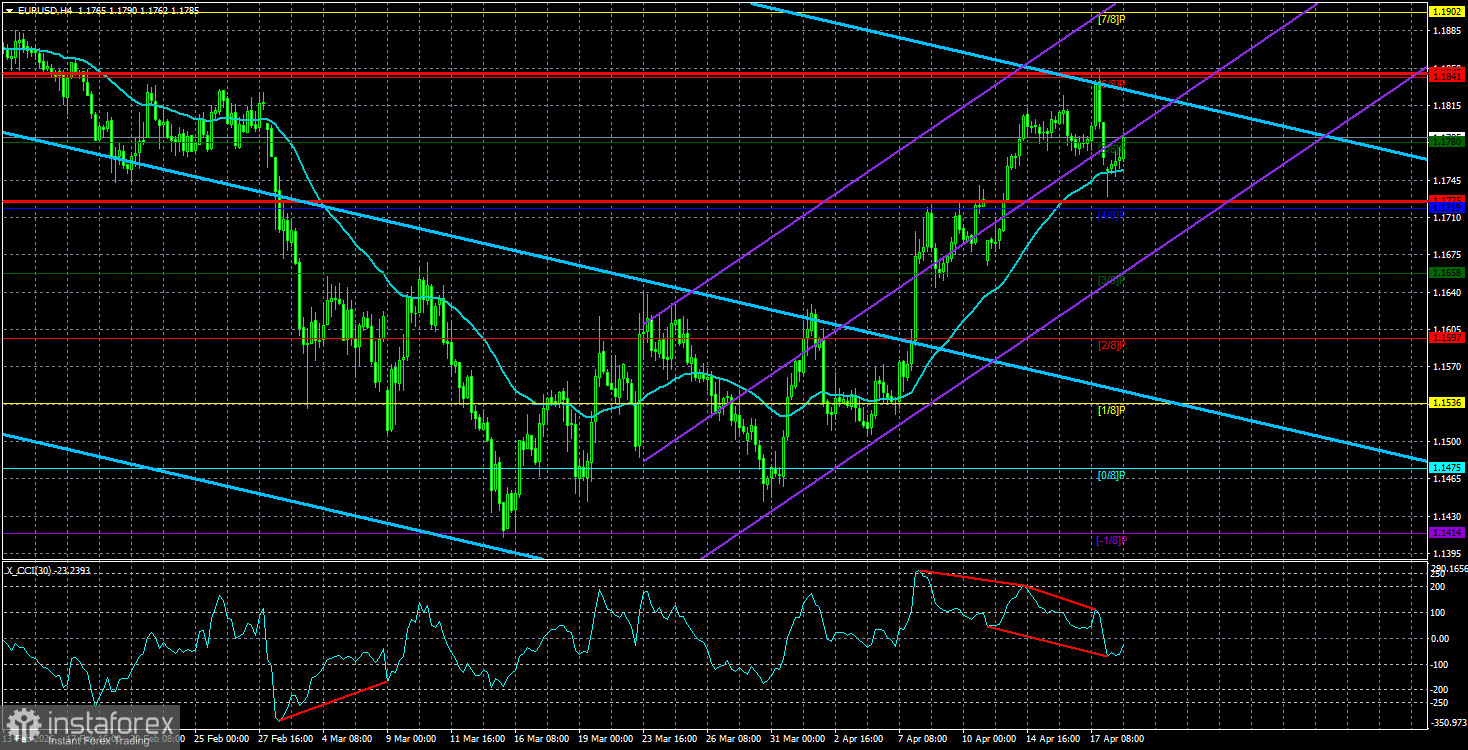
The EUR/USD currency pair traded quite calmly on Monday, especially in the first half of the day, despite the geopolitical backdrop. This backdrop, it must be said, remains filled with reports that do not indicate a quick end to the war in the Middle East. Over the past two weeks, markets have regained hope following the ceasefire between Iran and the US. However, the ceasefire was initially agreed upon as temporary. Perhaps many traders thought that great things start small, and if the parties actually sat down at the negotiating table, an agreement would eventually be reached. However, facts tell a completely different story.
To begin with, the Strait of Hormuz remained open for less than one day after Trump's statements. Then Tehran discovered with surprise that Iranian ports remained blocked by the US Navy and reintroduced its blockade. It's unclear who did not understand this situation. Initially, Tehran stated that it was lifting the blockade because Israel agreed to a 10-day ceasefire with Lebanon. However, it later became clear that Tehran was also expecting the lifting of the American blockade, even though this had not been mentioned beforehand. This marks the first case where it is no longer Trump making empty promises or issuing false statements, but Iran itself not understanding what it wants, what was agreed upon, and under what conditions to proceed.
However, traders, in principle, do not care who understood whom this time. The Strait of Hormuz remains closed, and the second round of negotiations, which was supposed to take place first on Saturday, then Sunday, and finally Monday, never occurred. In addition, the US fleet fired upon several Iranian vessels in the Persian Gulf, and Iran fired upon several foreign vessels attempting to leave the Gulf. So what is the outcome? The Strait is closed, the war continues, there are no negotiations, and the world is seriously beginning to search for alternative sources of oil and gas supplies, not expecting a quick end to the conflict in the Middle East.
So why didn't the US dollar show growth on Monday? We have already mentioned in recent weeks that the geopolitical factor has an expiration date. It seems that the conflict in the Middle East has an expiration date of approximately two months. Thus, the market initially priced in the war itself, then the temporary ceasefire, and now all events are accounted for. Of course, the situation may change in either direction, but we believe that from now on, the influence of geopolitics will be much less than before. Even Brent oil prices declined slightly on Monday, not reacting to the failure of negotiations or the new blockage of the Strait of Hormuz.
From a technical standpoint, the situation is currently quite complex. On the one hand, the dollar still has no reason to show growth other than geopolitical ones. But the geopolitical factor will likely no longer influence currency traders' mood as strongly as it did before. On the other hand, new escalations in the conflict could still provoke a couple of rounds of dollar growth, and after two weeks of rising, the EUR/USD pair needs correction.
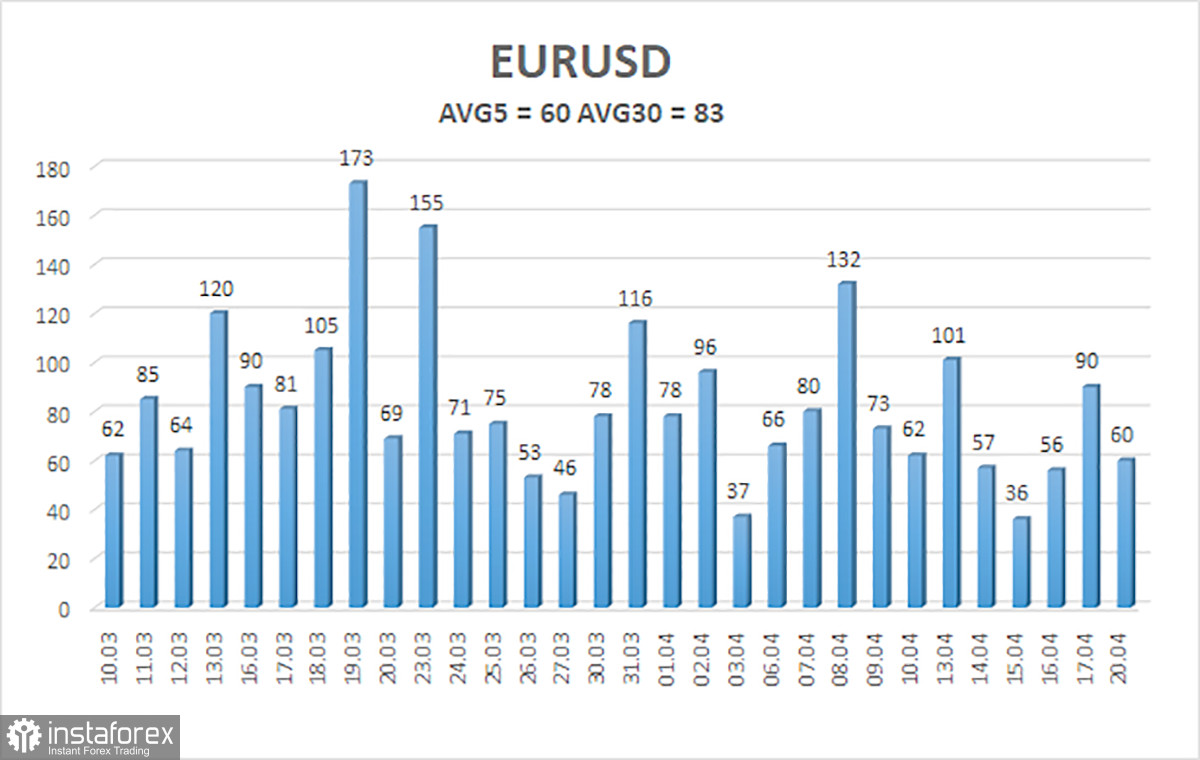
The average volatility of the EUR/USD currency pair over the last 5 trading days as of April 21 is 60 pips, which is considered "average." We expect the pair to trade between 1.1725 and 1.1845 on Tuesday. The upper linear regression channel has turned downward, signaling a bearish trend. However, in reality, the upward trend of 2025 may resume. The CCI indicator has entered overbought territory and formed a "bearish" divergence, warning of a downward pullback. A "bullish" divergence indicates a renewal of the upward trend.
The EUR/USD pair continues its upward movement amid a weakening geopolitical influence on market sentiment. The global fundamental backdrop for the dollar remains extremely negative, so in the long term, we still expect the pair to grow. When the price is below the moving average, short positions can be considered with targets of 1.1658 and 1.1597 based on technical grounds. Above the moving average line, long positions are relevant with targets of 1.1841 and 1.1902. The market is gradually moving away from the geopolitical factor, and the dollar is losing its only growth driver.
Linear regression channels help to define the current trend. If both are directed in the same way, it means the trend is currently strong;
The moving average line (settings 20,0, smoothed) determines the short-term trend and the direction in which trading should currently be conducted;
Murray levels are target levels for movements and corrections;
Volatility levels (red lines) indicate the probable price channel in which the pair will operate over the next day, based on current volatility readings;
The CCI indicator – its entrance into the oversold area (below -250) or the overbought area (above +250) indicates that a trend reversal in the opposite direction may be approaching.


