
See also


 07.09.2026 08:42 AM
The dollar moved back and forth reasonably well, but overall, if you look at the situation, the balance of forces has not changed significantly.
Yes, US employment rose by 162,000 in August against a consensus of only 55,000, and unemployment remained at 4.1%. But this report diverged sharply from all leading indicators at once, since ADP counted only 38,000, the ISM employment index in services remained in contraction, and the manufacturing ISM fell. At the same time, wages rose 3.1% year?on?year, without acceleration, which eases some inflationary concerns. For the euro and the pound, such a strong report was a short-term hit, and both European currencies gave ground to the dollar. But in my view, the situation for the Federal Reserve has not changed materially; rather, the dovish narrative that relied on a weak labor market has suffered. So, until the inflation report on September 11, pressure on EUR/USD and GBP/USD will persist, and the initiative will remain with the stronger dollar.
Today, the focus for the single currency will be on German industrial production figures and the Sentix investor confidence indicator. Still, a far more important item will be the revised Q2 eurozone GDP, along with employment data. In my opinion, the market will watch primarily whether the revised data confirm the prior picture of growth. If the figures match economists' forecasts, pressure on EUR/USD could return, as without a positive surprise the single currency will struggle to resist the dollar, strengthened by the strong US employment report. Nevertheless, I keep in mind the approaching European Central Bank meeting on September 10, where a rate hike to 2.5% is almost fully priced in, and I believe that anchor will limit the depth of any possible euro decline.
For the pound, there is no domestic data today at all, so bulls will have a chance to restore the pair after Friday's sell?off, but it is unlikely to leave its main sideways channel 1.3480–1.3545.
The essence of this approach is to wait for a decisive price exit beyond a key level and join the forming impulse rather than trying to guess a reversal in advance. Breakout models are good precisely when the market gains momentum, and big players begin to push price in one direction, so I prefer to act strictly on the breakout rather than in anticipation.
For the EURUSD pair. I consider long positions on a breakout of 1.1621. In my view, a close above this level can open the euro's path to 1.1641 initially and, if momentum continues, to the further target 1.1657. Sequential clearing of these levels will indicate that initiative has truly passed to buyers. From the opposite side, look for short positions on a breakout of 1.1601, since a drop below it opens room to 1.1587 and then to 1.1568. While the pair is trapped between these boundaries, I prefer to remain patient and wait for a clean breakout rather than enter inside the range.
For the GBPUSD pair. I plan to buy on a breakout of 1.3521, because a close above it can push the pound toward 1.3545 and, if the move develops, to 1.3573. Short positions make sense on a breakout of 1.3501, since breaking it would hit buyers' positions and open the way down to 1.3480 and then to 1.3457. As with the euro, I bet on impulse rather than trying to catch moves inside the boundaries where signals are too often false.
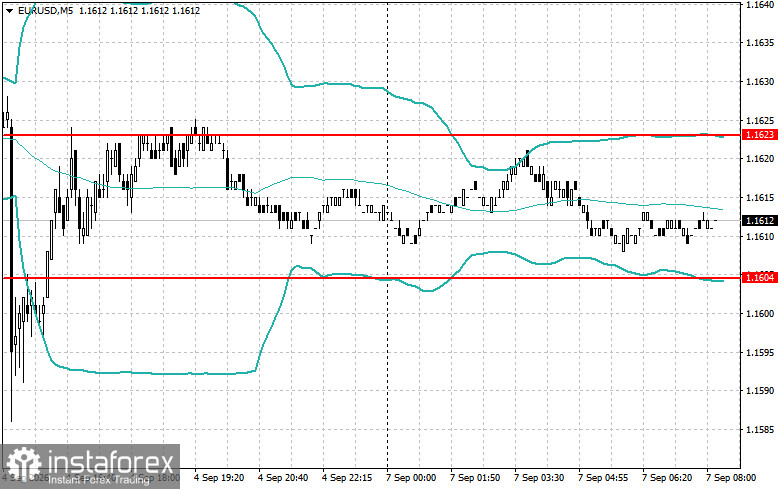
This approach is opposite in logic and is built on the idea that not every breach becomes a real breakout. Often price punctures an important level but fails to find support from large participants and returns, and such failed exits provide some of the most reliable entry points. Here I don't chase the impulse but work against it, waiting until a false breakout is exhausted.
For the EURUSD pair. I will look for short positions after a failed exit above 1.1623 when price returns below that level, since such a scenario usually indicates buyers lack the strength to hold above and initiative passes to sellers. Conversely, I'll look for longs after a failed attempt to push below 1.1604, on the price's return to that level, which will signal exhaustion of bearish pressure. In both cases, the key signal for me is the fact of the return itself, not the initial poke through the level.
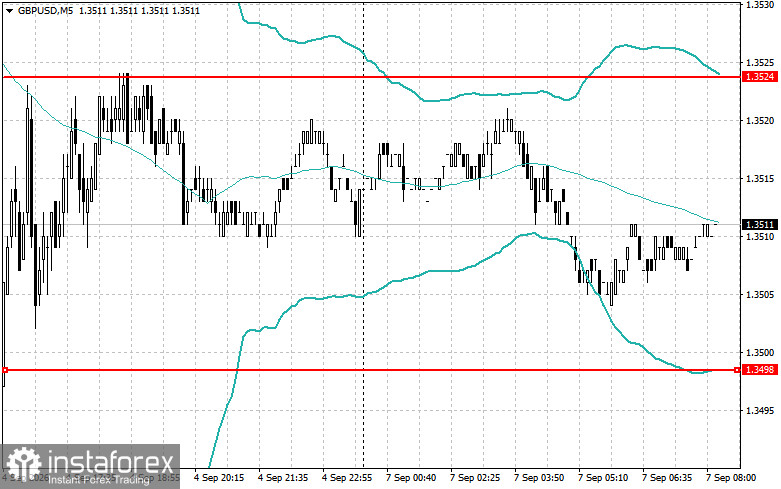
For the GBPUSD pair. The logic is identical. I will look for shorts after a failed exit above 1.3524 on a return below that level, and for longs after a failed attempt to hold below 1.3498 on a return to that level. Such entry points are good because they imply limited risk and a clear stop placement. If the return does not occur and price instead continues the breakout, the signal is immediately invalidated, and I prefer to step away and wait for the next opportunity.


