
Vea también


 15.09.2026 12:38 AM
Bank of England chief Andrew Bailey admitted at Commons Treasury Committee hearings that inflationary risks are "tilted to the upside" and said plainly that volatility in energy prices is being transmitted into financial markets. At the same time, he categorically rejected the existence of any "secret plan to raise rates." Bailey noted that mortgage rates in the UK have increased by roughly 75 basis points since the start of the Gulf conflict — the sharpest rise among G7 countries.
Economic data are mixed. GDP rose 0.4% month-on-month in July, but the industrial picture looks much darker — output fell 0.5% over three months. Trade figures show weak exports alongside resilient imports, deepening a structural deficit driven by dependence on energy imports.
Although energy prices have already reached the "adverse scenario" built into the Bank of England's July forecast, evidence of secondary effects remains weak.
The situation in the Persian Gulf adds a decisive variable to an already complex picture. Brent has risen to $110 per barrel, and peak values of the UK gas curve reach 210 pence per therm — levels that seemed unlikely a few months ago. NIESR projects inflation to peak at 3.8% in February 2027, with a return to the 2% target delayed until 2029. Household arrears on energy bills have exceeded £4 billion.
Traders are pricing in roughly 47 basis points of rate hikes for sterling by year-end.
A higher rate relative to the euro area supports sterling via the interest-rate differential, but any data confirming the transmission of the energy shock into core inflation could reprice markets toward further tightening. That would lift the pound in the short term but at the cost of worsening growth prospects.
The August inflation report will show whether headline inflation continues to rise while core remains stable — a result that would allow the Bank of England to pause without losing credibility.
According to the CFTC report, the net short position on the pound grew by £0.8 billion over the week to –£4.97 billion. Speculative positioning remains bearish; the implied price momentum has weakened and is likely to move below its long-term average.
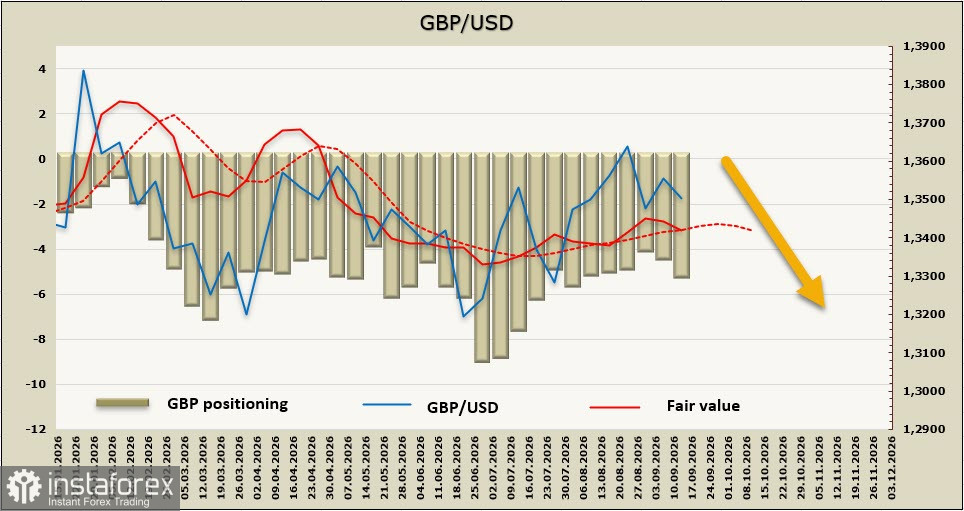
A week earlier, we suggested the pound would retain a bullish bias if Federal Reserve rate expectations did not change. The market did not disappoint and now sees the Fed hiking on Wednesday, which logically strengthens the dollar. GBP/USD has approached support at 1.3460–1.3470, and the odds of a breakout have risen materially. We don't expect the pound to close decisively below this level before the FOMC decision on September 16, but the chances of a bearish break have clearly increased. If the Fed does not disappoint, the next target will be support at 1.3425. There are noticeably fewer grounds now to expect a renewed rise.


