
Vea también


 11.06.2026 09:36 AM
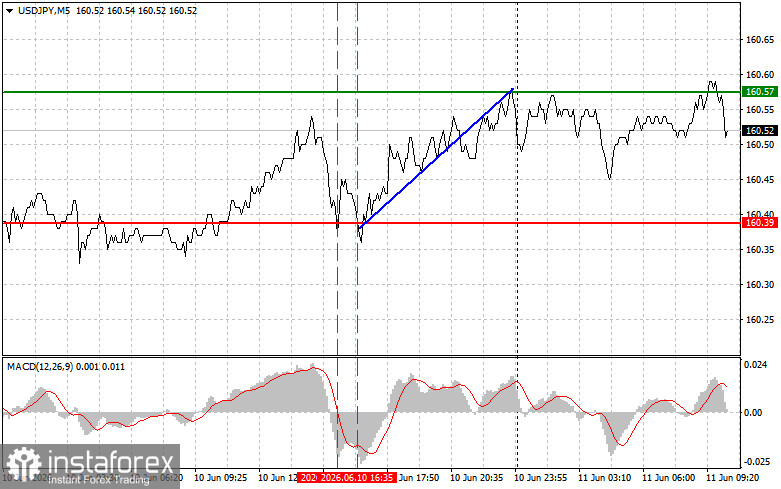
The price test at 160.39 coincided with the moment when the MACD indicator had moved significantly below the zero mark, limiting the pair's downward potential. The second test of this price led to the implementation of scenario #2 for buying dollars, resulting in a 20-pip increase in the pair.
The rise in overall inflation in the US to 4.2% in May is a significant indicator warranting close attention. However, the lower core inflation figure, which excludes fluctuations in energy and food prices, suggests potential stability in inflation expectations among consumers and businesses alike. This is reflected in the absence of a pronounced strengthening of the dollar and the decline of the Japanese yen. Furthermore, the global geopolitical risks arising from the Middle East will continue to influence appetite for risk or safe-haven assets.
Going forward, the trajectory of USD/JPY will also depend on the Bank of Japan's currency interventions, as a level above 160 clearly exceeds the central bank's strategy. However, considering that an upcoming BoJ meeting will discuss an interest rate hike, it is unlikely that any emergency measures will be taken for now.
As for the intraday strategy, I will rely more on implementing scenarios #1 and #2.
Scenario #1: I plan to buy USD/JPY today upon reaching an entry point around 160.61 (green line on the chart) with a target growth to the level of 160.95 (thicker green line on the chart). At point 160.95, I plan to exit the market and open short positions in the opposite direction, expecting a move of 30-35 pips from the entry point. It is best to return to buying the pair during corrections and significant dips in USD/JPY. Important! Before buying, ensure that the MACD indicator is above the zero mark and just beginning to rise from it.
Scenario #2: I also plan to buy USD/JPY today in the event of two consecutive tests of the price at 160.47, at a time when the MACD indicator is in the oversold area. This will limit the pair's downward potential and lead to an upward market reversal. One can expect growth to the opposite levels of 160.61 and 160.95.
Scenario #1: I plan to sell USD/JPY today only after the level of 160.47 (red line on the chart) is updated, which will lead to a rapid decline in the pair. The key target for sellers will be 160.14, where I plan to exit short positions and immediately open long positions in the opposite direction (expecting a move of 20-25 pips in the opposite direction from that level). Sellers may return at any moment; a hint from the central bank is all that is needed. Important! Before selling, ensure that the MACD indicator is below the zero mark and just beginning to decline from it.
Scenario #2: I also plan to sell USD/JPY today in the event of two consecutive tests of the price at 160.61, at a time when the MACD indicator is in the overbought area. This will limit the pair's upward potential and lead to a downward market reversal. One can expect a decline to the opposite levels of 160.47 and 160.14.
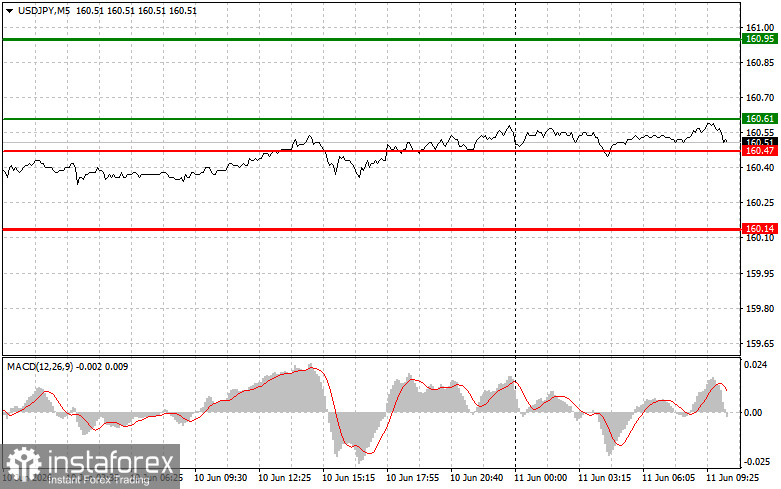
Thin green line – entry price for buying the trading instrument;
Thick green line – presumed price level for placing Take Profit or manually securing profits, as further growth above this level is unlikely;
Thin red line – entry price for selling the trading instrument;
Thick red line – presumed price level for placing Take Profit or manually securing profits, as further decline below this level is unlikely;
MACD Indicator. When entering the market, it is important to consider the overbought and oversold zones.
Important: Beginner traders in the Forex market must be very cautious when making entry decisions. Before major fundamental reports are released, it is best to stay out of the market to avoid being caught in sharp fluctuations. If you decide to trade during news releases, always set stop orders to minimize losses. Without setting stop orders, you can quickly lose your entire deposit, especially if you are not using money management and are trading large volumes.
And remember, for successful trading, you need a clear trading plan similar to the one presented above. Making spontaneous trading decisions based on the current market situation is inherently a losing strategy for intraday traders.


