
Vea también


 22.01.2026 05:19 AM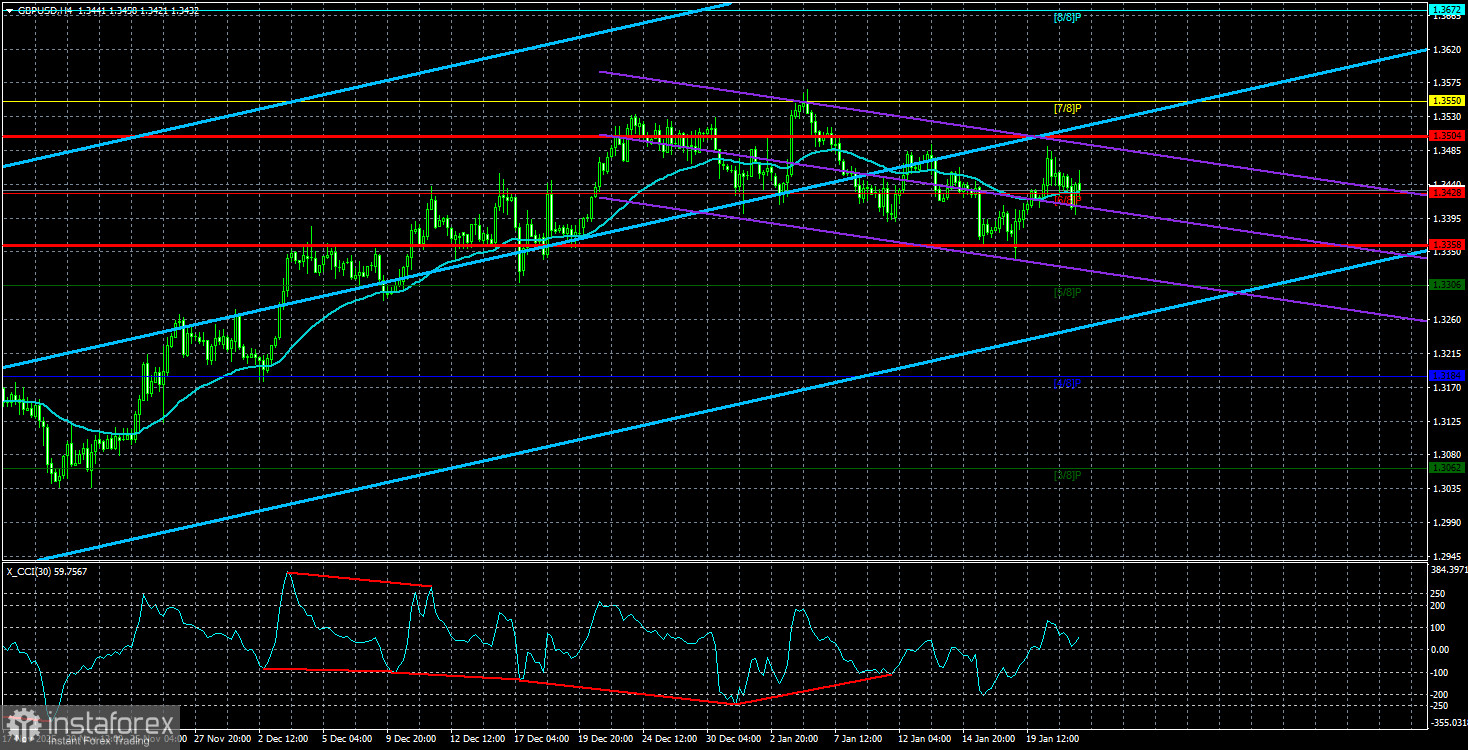
The GBP/USD currency pair does not want to follow EUR/USD, although that would be the most logical outcome. Recall that most of the time, the euro and the pound trade almost identically, but not this week. If the euro is confidently rising, the pound sterling is mostly standing still or correcting. What caused the pound's decline on Tuesday and Wednesday if the fundamental backdrop points in the opposite direction?
Many traders might answer — macroeconomic reports. Let's see if that is the case. On Tuesday, two important reports were published in the UK: the unemployment rate and the change in the number of unemployed. The unemployment rate was worse than forecasts, but showed no change for November. The change in claimant numbers matched expert expectations. Thus, the Tuesday package of reports can be considered neutral for the pound.
On Wednesday, the UK inflation report was published. While core inflation remained unchanged at 3.2% in line with forecasts, headline inflation accelerated again to 3.4%. What does this acceleration mean? Only one thing — the Bank of England should delay the next monetary easing. We noted earlier that inflation in the UK remains high enough to rule out rate cuts at every other meeting. Despite the slowdown in recent months, inflation remains more than one and a half times the Bank's "norm." In other words, reaching the central bank's target will be a long process. Therefore, if the Bank of England continues to cut the key rate, it risks failing to achieve 2% inflation in the coming years.
Thus, one can assume that at the next meeting, the Bank of England will leave monetary policy settings unchanged, which is good for the pound. It follows that Tuesday's reports could not have triggered the pound's fall, and Wednesday's inflation reports should have triggered a rise. Instead, we observed anything but a rise in GBP/USD.
We believe that, under current circumstances, GBP/USD's behavior is to some extent accidental. If the technical picture on lower timeframes is unclear, one should move to higher timeframes. On the daily chart, the 2025 uptrend remains valid, and the price sits above the Ichimoku cloud. Thus, we believe that the pound's rise will resume in almost any case. Over the past two months, the pound has strengthened by 400 pips. However, keep in mind that market volatility remains quite low. Therefore, 400 pips of gain is a lot.
The key factor supporting the pound's rise remains Donald Trump's policy. In other words, it is not the pound that is rising; it is the dollar falling. And it will continue to fall while Trump imposes new tariffs, attempts to disband the FOMC, fires officials who disagree with him, seeks control over entire countries and vast territories, and stages military coups in sovereign states.
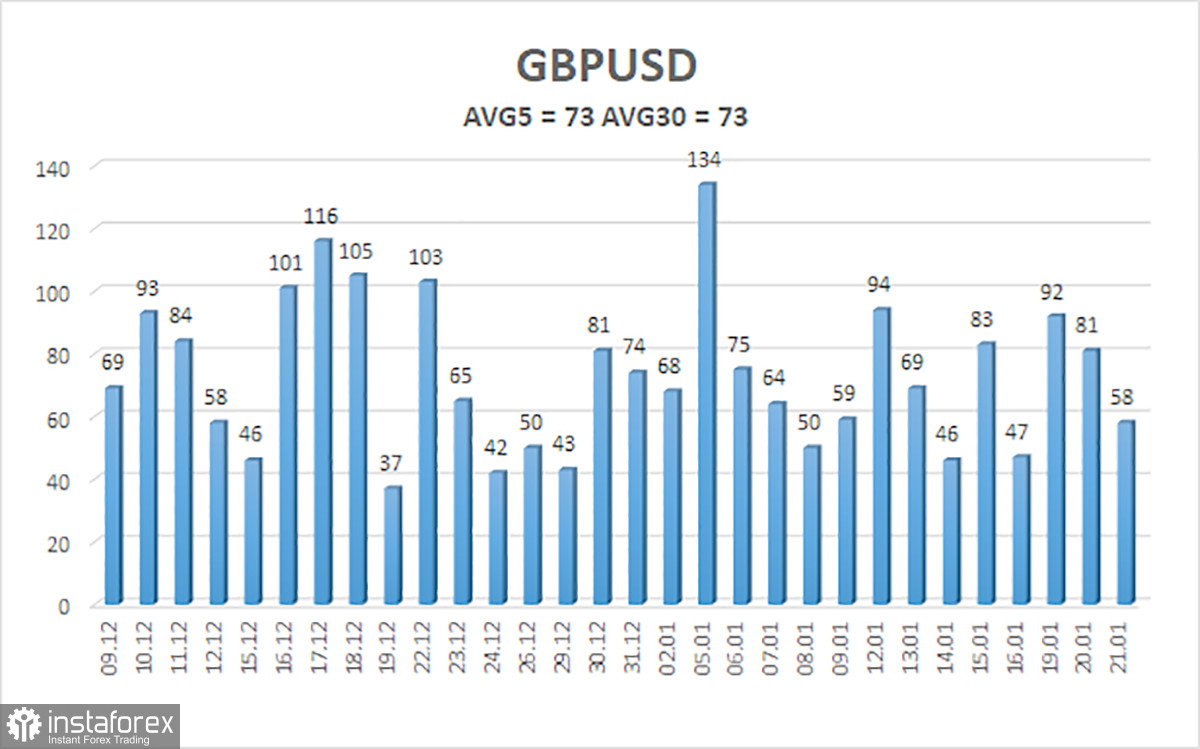
The average volatility of GBP/USD over the last 5 trading days is 73 pips. For the pound/dollar pair, this value is "medium." On Thursday, January 22, we therefore expect movement within the range bounded by 1.3358 and 1.3504. The higher linear regression channel is directed upward, indicating trend recovery. The CCI indicator has entered oversold territory six times in recent months and has formed numerous bullish divergences, consistently signaling the continuation of the uptrend.
S1 – 1.3428
S2 – 1.3306
S3 – 1.3184
R1 – 1.3550
R2 – 1.3672
R3 – 1.3794
The GBP/USD pair is attempting to resume the 2025 uptrend, and its long-term outlook remains unchanged. Donald Trump's policy will continue to put pressure on the US economy, so we do not expect the dollar to strengthen. Thus, long positions with targets at 1.3550 and 1.3672 remain relevant for the near term while the price is above the moving average. A price below the moving average suggests consideration of small short positions targeting 1.3306 on technical grounds. From time to time, the US currency shows corrections (in the global view), but for a trend to strengthen, it needs global, positive factors.


