
Veja também


 09.07.2026 09:01 AM
The publication of the last Federal Reserve meeting's minutes passed virtually unnoticed for Bitcoin and Ethereum, which in itself is telling.

The document confirmed the unanimous decision to maintain the rate in the 3.50-3.75% range, but what was more important was the rhetorical detail: the central bank removed even the hint of further monetary easing from the statement. Typically, such a scenario is a bearish signal for risk assets, including the cryptocurrency market. The Fed directly links the persistent inflation above the target of 2% with tariffs, energy prices, and the conflict in the Middle East.
The lack of reaction from Bitcoin to such a fundamentally tough document can be logically explained by the fact that the market has already endured the main shock earlier. It was the first Fed meeting under Kevin Warsh's leadership in June when the updated dot plot turned from a forecast of cuts to a forecast of hikes, and the wording about easing completely disappeared from the statement, which marked the event that truly crashed the crypto market and set the current tone. The minutes merely documented ex post the market movements that had already been played out weeks earlier. Nevertheless, fundamental pressure on the crypto market from monetary policy remains fully intact. The Fed's hawkish stance means that cheap money capable of fueling another bullish cycle will not emerge in the foreseeable future, while the likelihood of a rate increase, should inflation continue to rise amid tariffs and AI investments, adds yet another layer of uncertainty to an already tense backdrop.
Regarding short-term trading, the strategy and conditions are described below.
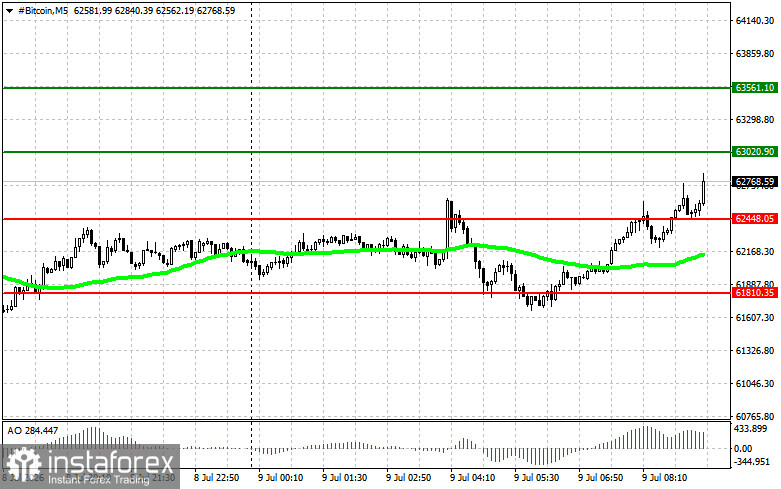
Scenario #1: I plan to buy Bitcoin today upon reaching an entry point around $63,000, targeting growth to the level of $63,500. Around $63,500, I plan to exit my buy positions and sell immediately on a retracement. Before buying on the breakout, ensure that the 50-day moving average is below the current price, and the Awesome indicator is above zero.
Scenario #2: Bitcoin can be bought from the lower boundary of $62,400 if there is no market reaction to its breakout in the opposite direction toward levels $63,000 and $63,500.
Scenario #1: I plan to sell Bitcoin today upon reaching an entry point around $62,400, targeting a decline to the level of $61,800. Around $61,800, I plan to exit my sell positions and buy immediately on a retracement. Before selling on the breakout, ensure that the 50-day moving average is above the current price, and the Awesome indicator is below zero.
Scenario #2: Bitcoin can be sold from the upper boundary of $63,000 if there is no market reaction to its breakout in the opposite direction toward levels $62,400 and $61,800.
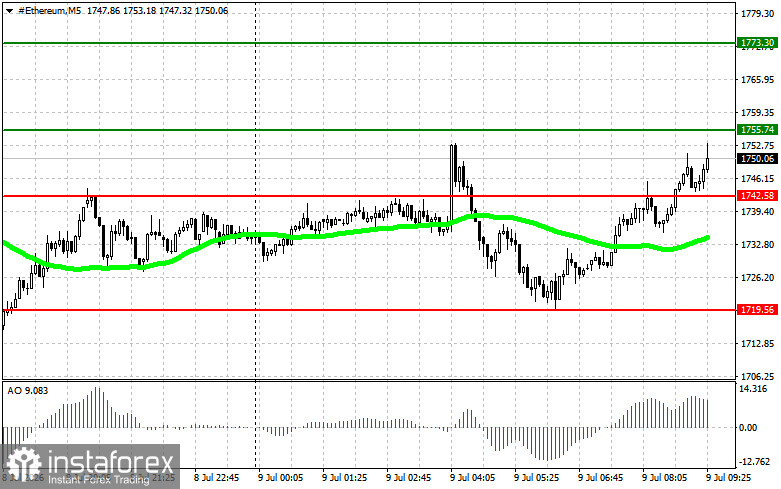
Scenario #1: I plan to buy Ethereum today at an entry point around $1,755, targeting growth to $1,773. Around $1,773, I plan to exit my buy positions and sell immediately on a retracement. Before buying on the breakout, ensure that the 50-day moving average is below the current price, and the Awesome indicator is above zero.
Scenario #2: Ethereum can be bought from the lower boundary of $1,742 if there is no market reaction to its breakout in the opposite direction toward levels $1,755 and $1,773.
Scenario #1: I plan to sell Ethereum today upon reaching an entry point around $1,742, targeting a decline to the level of $1,719. Around $1,719, I plan to exit my sell positions and buy immediately on a retracement. Before selling on the breakout, ensure that the 50-day moving average is above the current price, and the Awesome indicator is below zero.
Scenario #2: Ethereum can be sold from the upper boundary of $1,755 if there is no market reaction to its breakout in the opposite direction toward levels $1,742 and $1,719.


