
یہ بھی دیکھیں


 22.06.2026 01:27 AM
Bitcoin has recovered to approximately $8,000 after dropping to $22,000. Currently, there are no signs of a conclusion to the upward correction, nor any indication that the downward trend that began last year has ended. On the 4-hour timeframe, an upward structure is maintained, while on the daily timeframe, a downward trend persists. Thus, everything is clear. The daily timeframe shows a clear target for the correction— a "bearish" Fair Value Gap (FVG). A reaction to this FVG is expected, leading to the resumption of the downward trend. The correction may take a considerable amount of time, as we have recently seen—the cryptocurrency corrected for three months.
It is also worth noting the liquidity removal on the daily (or weekly) timeframe from the February 6 low. However, it should be remembered that liquidity removal during corrections is a manipulation by market makers, who typically possess certain characteristics. When large capital gains have access to the necessary liquidity, aggressive trading begins, which we do not currently observe. Demand for "digital gold" remains low, miners are increasingly transitioning to the AI sector, the Federal Reserve is poised to tighten monetary policy in 2026, and the military conflict in the Middle East cannot be considered resolved. Thus, we do not yet see fundamental or technical grounds for a bullish trend.
Bitcoin has been trading below the break-even level for five consecutive months. Analysts estimate that the average cost of mining one coin of "digital gold" is about $78,000. Bitcoin is currently priced around $64,000, making the mining process unprofitable for many operators. In the first quarter of 2026, mining companies sold about 32,000 bitcoins, more than in all of 2025. Companies are forced to sell cryptocurrency to cover the costs associated with mining it. As a result, supply on exchanges has increased, while demand (as we have repeatedly noted in our articles) remains very low. Consequently, some miners are even forced to shut down their equipment, reducing the hashrate and mining difficulty.
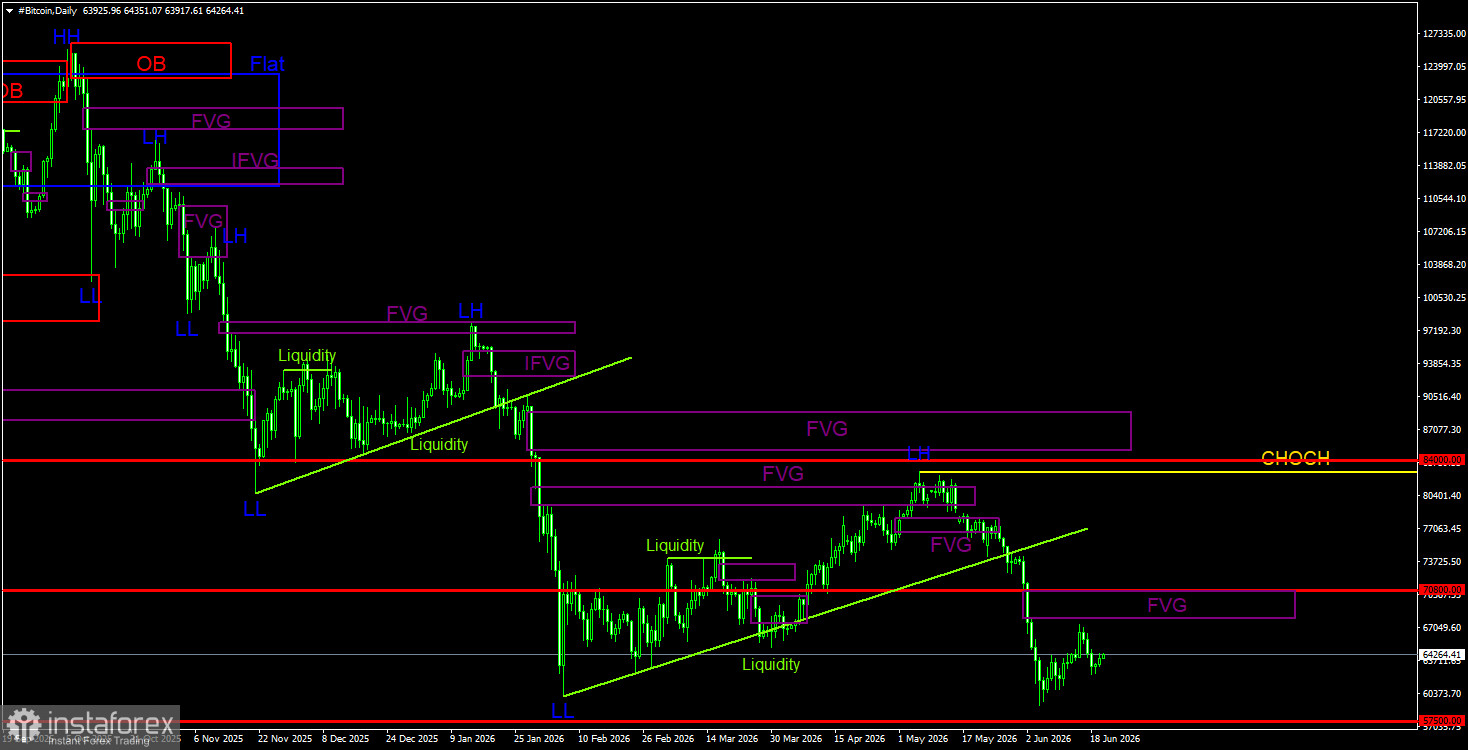
On the daily timeframe, Bitcoin continues to form a downward trend. The trend structure is bearish, and the CHOCH line has been established at $82,800 after a new Lower Low (LL) formed. Only above this level can we consider the downward trend to be completed. Since there are still no signals of an upward trend reversal, we believe that the decline will continue. A new bearish Fair Value Gap (FVG) has formed between $68,000 and $70,700. Within this pattern, new sell signals may be generated. However, the pattern has not been activated at the moment.
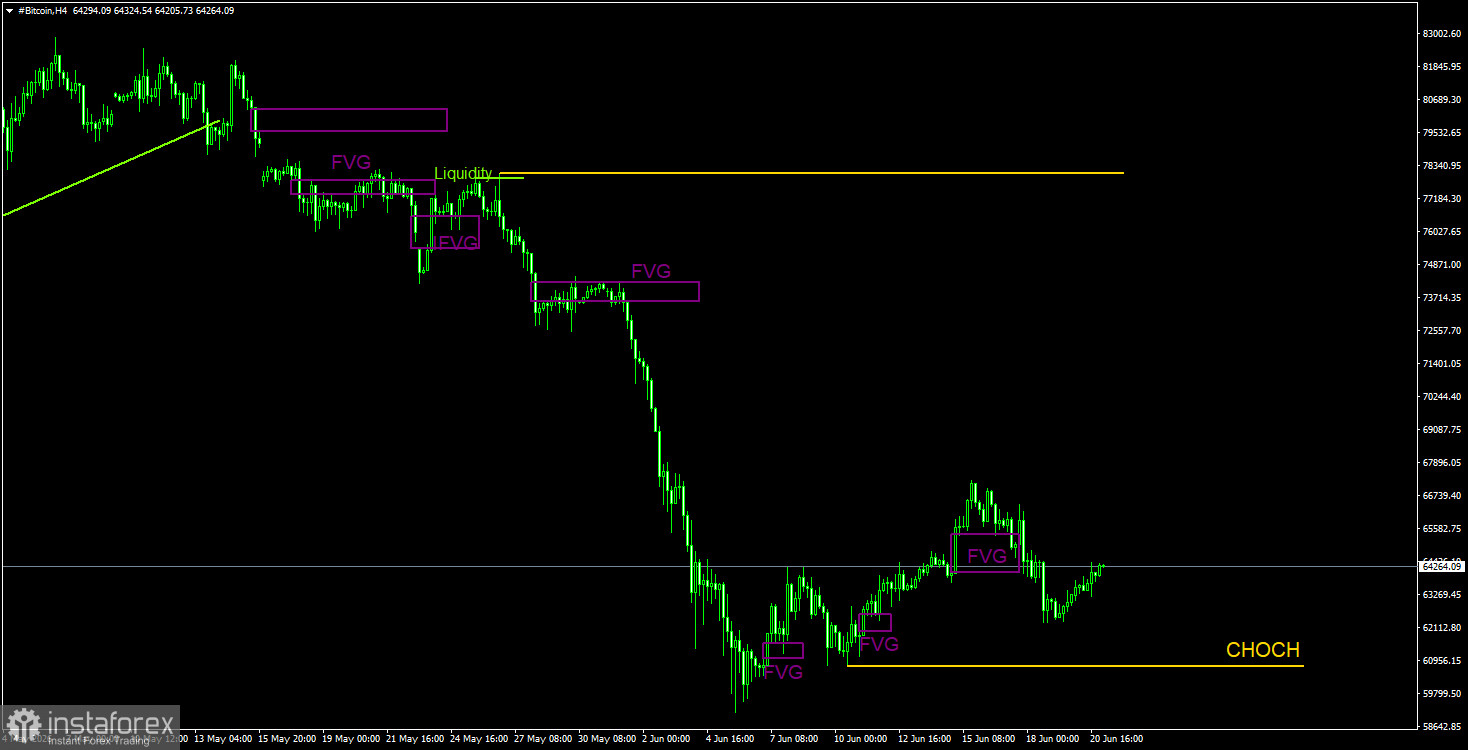
On the 4-hour timeframe, Bitcoin continues its upward correction. The CHOCH line supporting the correction is at $60,765. Bearish patterns can be used to open new short positions, but it is better to use the daily timeframe for this purpose. As for buy trades, they are feasible from bullish patterns on the 4-hour timeframe, but one should understand that significant growth in a downward trend is unlikely. The last bullish pattern (FVG) in the $64,100 to $65,370 area did not produce a significant reaction, and a structural break on the M30 timeframe (as confirmation) did not occur either. A structural break (breaching the CHOCH line) would indicate a possible resumption of the main trend.
Bitcoin continues to form a full-fledged downward trend with a correction against it. We continue to expect a decline, with a target of $57,500 (the 61.8% Fibonacci level of a three-year upward trend), and there are still no signs of an upward trend emerging. The last bearish FVG formed in the $68,000 to $70,700 range, making it a point of interest (POI) for short positions in the coming weeks. On the 4-hour timeframe, the cryptocurrency may soon experience an upward correction, so if traders wish to trade against the trend, they can consider small long positions based on bullish patterns. However, this correction could end at any moment.


