
یہ بھی دیکھیں


 01.09.2025 08:25 AM
The test of the 147.11 price level coincided with the moment when the MACD indicator was starting to move down from the zero line, confirming the correct entry point for selling the dollar. As a result, the pair declined by 25 pips.
Friday's US Personal Consumption Expenditures (PCE) index did not surprise and matched economists' forecasts, which weakened the dollar against the Japanese yen. However, it's too early to count the dollar out. The market's response was moderate, reflecting investors' understanding of the complex dilemma facing the Federal Reserve. On one hand, weak inflation data creates room for monetary easing. On the other hand, cutting rates too early could reignite inflation and weaken the dollar further, which is unacceptable.
The weakening of the dollar against the yen, in turn, reflects not only the US situation but also the yen's own dynamics. The Bank of Japan is not yet planning to tighten monetary policy, but there are signs that changes may come by year's end. This supports the yen, despite the general weakness in the Japanese economy. Japan's weak Manufacturing PMI is direct evidence of this.
The published data, which indicate a contraction in the manufacturing sector, deepen concerns about the overall trajectory of the Japanese economy. A reduction in export orders, caused by global economic uncertainty and weaker demand from major trading partners, has a negative impact on manufacturing metrics.
For intraday strategy, I will focus primarily on Scenarios #1 and #2.
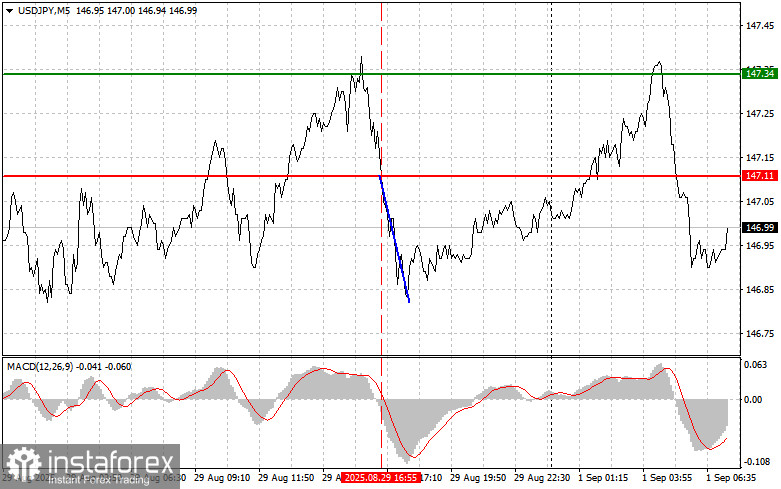
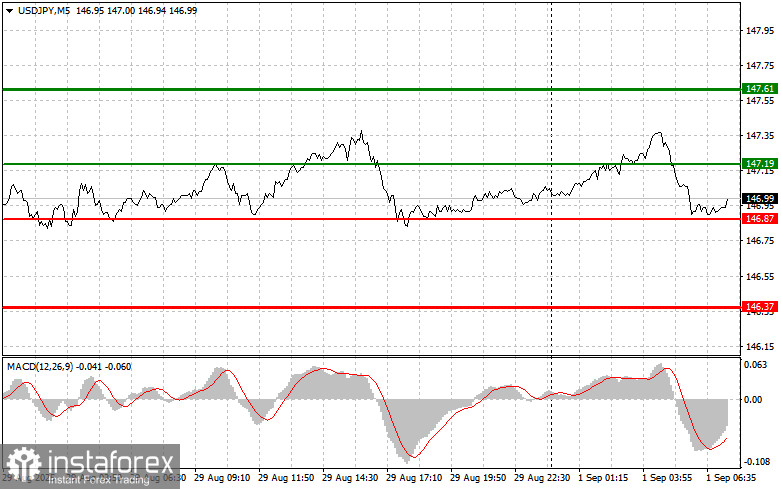
Thin green line – entry price at which the instrument can be bought.
Thick green line – suggested price for taking profit or manually securing profits, as further growth above this level is unlikely.
Thin red line – entry price at which the instrument can be sold.
Thick red line – suggested price for taking profit or manually securing profits, as further decline below this level is unlikely.
MACD indicator: When entering the market, it is important to refer to overbought and oversold areas.
Important. Beginner forex traders should exercise extreme caution when making entry decisions. Before important fundamental reports, it is best to stay out of the market to avoid sharp price swings. If you decide to trade during the release of news, always use stop-loss orders to minimize losses. Without stop-losses, you can quickly lose your entire deposit, especially if you don't use money management and trade large volumes. And remember: for successful trading, you need a clear trading plan, as I described above. Making spontaneous trading decisions based on the current market situation from moment to moment is a losing strategy for an intraday trader.


