
Lihat juga


 27.05.2026 04:41 AM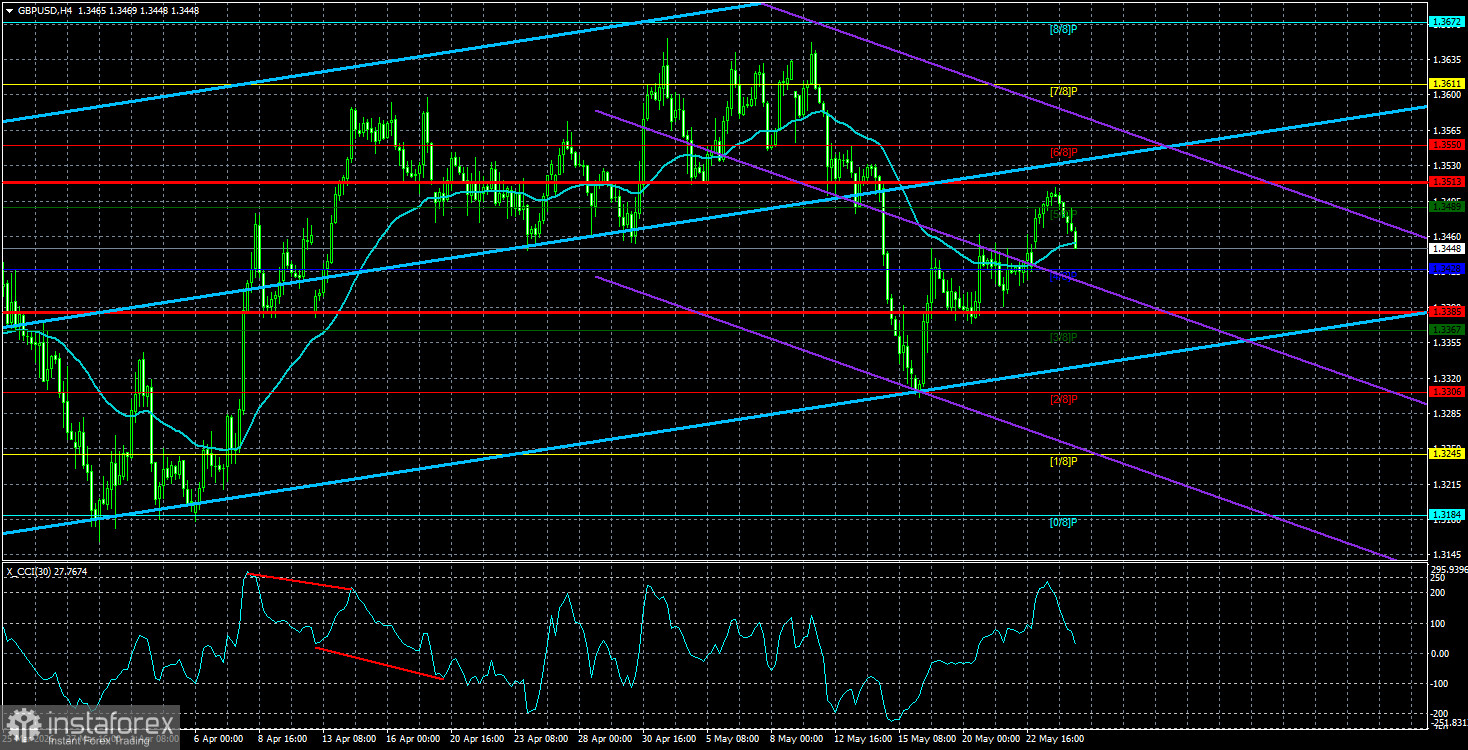
The GBP/USD currency pair also traded with low volatility on Tuesday, which has been trending downwards lately, as clearly seen in the chart below. It seems there is no shortage of geopolitical news, but much of it is either directly contradictory or unfounded and, frankly, false. Tehran and Washington cannot agree even on the most trivial issues. What "nuclear deal" can we talk about if Tehran considers it acceptable to mine the Strait of Hormuz while it should be preparing for its reopening, and Washington finds it permissible to launch new strikes against Iranian facilities and vessels while simultaneously declaring, "We are nearing an agreement"? Thus, we remain highly skeptical of absolutely all statements from Donald Trump.
While the market used to respond to his remarks, leaving traders with no choice but to track any message from the White House, the market's reaction to each piece of news is now more than restrained. The British pound has not been stagnant like the euro; there are reasons for that. The pound is historically less stable than the euro and more volatile. On Tuesday, the GBP/USD pair dipped slightly when news broke of new U.S. military strikes on Iranian facilities and boats.
What's next? Unfortunately, no one in the world can answer this question right now—not even Trump. If the conflicting parties somehow manage to reach at least a preliminary agreement, that would already be a victory. But it's a victory in the 95th minute, with a questionable penalty that could be overturned at any moment due to repeated violations of the rules by both teams throughout the match. Suppose a memorandum of understanding is signed. How does it differ from the ceasefire currently in place, which does not prevent the parties from regularly violating it? Will the memorandum open the Strait of Hormuz? Yes, possibly, but a new violation of the ceasefire could shut it down just as quickly. Therefore, the parties are moving not toward a deal but toward a pretty document that can later be used to accuse the opposing side of violating its terms.
Thus, for the British currency to experience significant growth, a real ceasefire, a truce, an agreement, and the opening of the Strait of Hormuz are necessary. There are no reasons for the U.S. currency to rise either, as the "strange ceasefire" remains in effect, the "strange negotiations" continue, and the parties are limited to infrequent strikes against each other. Who will lose patience first? One might want to bet on Trump, but the U.S. president also wants to avoid escalation, just as Tehran does. War benefits no one, especially Trump, who has the U.S. Congressional elections looming. Therefore, it seems the conflict will drag on for a long time, negotiations will continue even longer, and if the Strait of Hormuz does open, it will likely be for only a short time.
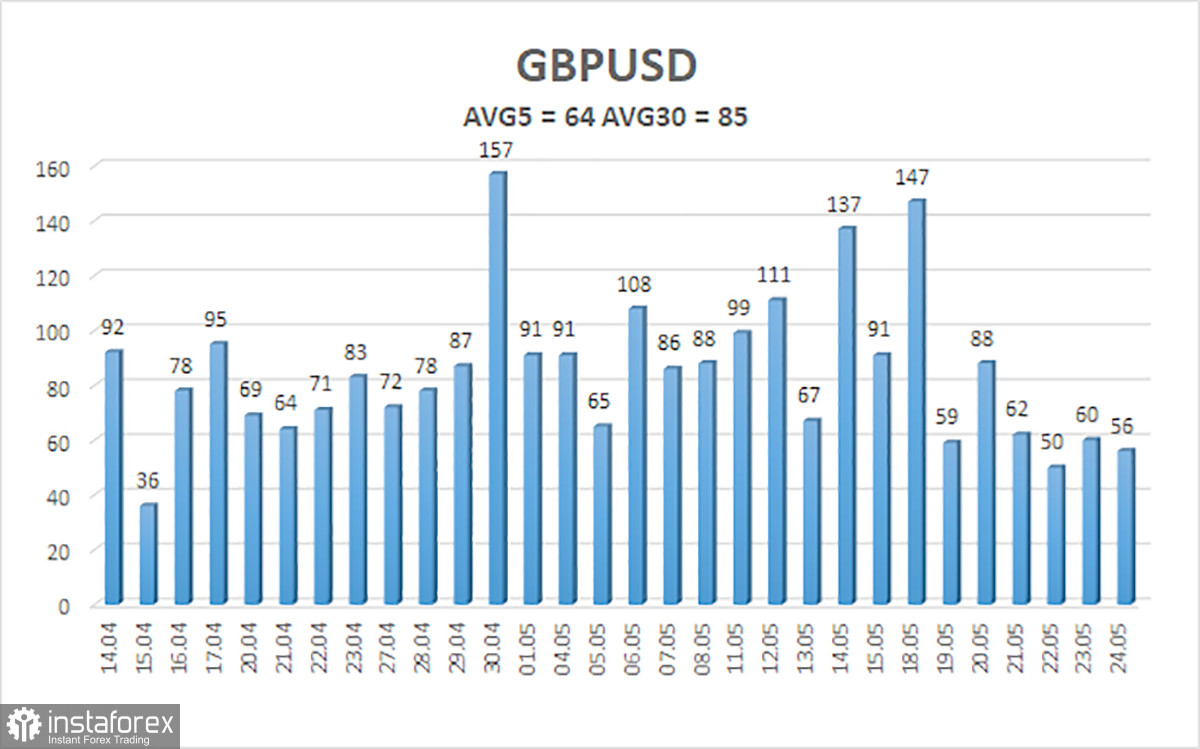
The average volatility of the GBP/USD pair over the last 5 trading days is 64 pips, characterized as "average." Therefore, on Wednesday, May 27, we expect the pair to move within a range limited by levels 1.3385 and 1.3513. The upper channel of the linear regression is directed upward, indicating a recovery of the upward trend. The CCI indicator has not formed any signals recently.
S1 – 1.3428
S2 – 1.3367
S3 – 1.3303
R1 – 1.3489
R2 – 1.3550
R3 – 1.3611
The GBP/USD currency pair continues to recover after the 300-point drop. Trump's policies will continue to exert pressure on the U.S. economy, so we do not expect the American currency to show long-term growth. However, 2026 appears to be quite positive for the dollar. Thus, long positions with targets of 1.3550 and 1.3611 can be considered when the price is above the moving average. When the price is below the moving average line, short positions can be traded with targets of 1.3385 and 1.3367 based on geopolitical factors. The situation in the market frequently changes, and the market continues to primarily track geopolitical news, which does not exhibit a uniform character.


