
यह भी देखें


 17.09.2026 08:03 AM
Yesterday the market experienced the week's main event — the Federal Reserve's rate decision — and its consequences fully determined the balance of power between the dollar, the euro and the pound. The dollar strengthened sharply against both currencies; the euro and the pound fell in sync, with the pound suffering more after a negative UK data print.
I'll start with Europe. This morning the final euro-area inflation reading for August is released — expected at 3.3% year-on-year headline and 2.4% core. These are not brand-new figures so much as a consolidation of what Germany, France, Spain and Italy have already published over the past days — a kind of wrap-up before the next European Central Bank meeting. If the figure comes in materially above forecasts, the euro will have a real chance to claw back part of yesterday's losses: higher inflation would give ECB hawks extra argument and at least partially offset the Fed's sharply increased resolve. If the data match expectations or are weaker, the pair will most likely consolidate under the weight of yesterday's Fed decision without its own reason to rally.
The pound, unlike the euro, has its own major event today — the Bank of England's rate decision and policy statement. Economists expect the cash rate to be held at 3.75%, but the intrigue lies elsewhere: UK inflation unexpectedly accelerated to 3.1% yesterday, materially above the central bank's forecast, and now the market will watch whether the BoE acknowledges that the pickup is driven not only by external factors like oil but also by domestic demand. If the BoE's tone proves tougher than expected, that could trigger pinpoint sterling buying and a small correction after yesterday's large sell-off. For now, the pound trades under the weight of two negative factors — yesterday's weak inflation narrative for the currency and the Fed decision that hit all currencies against the dollar.
Now to the main point. The Fed raised the policy rate by 25 basis points yesterday, and the decision was surprisingly unanimous — 12 to 0. In contrast, in July three FOMC members had pressed for immediate tightening instead of a pause. Chair Kevin Warsh cited three reasons: the labor market and the economy improved, disinflation is proceeding too slowly, and geopolitical risks altered the overall configuration. He also stressed that financial conditions are not truly tight, leaving the Fed room to act further. Even more important than the hike itself was the revised projection: the median year-end policy rate rose to 4.125% from 3.75%, and 16 of 18 Fed officials expect at least one more hike this year. The new projection suggests the policy rate will remain elevated through 2027 and decline only in 2028.
For the market, this is a far more serious signal than a one-off hike — it is a claim for a prolonged tightening cycle. That is why the dollar strengthened broadly rather than simply reacting to the expected number. For the euro, this widens the divergence with the ECB: the ECB remains the most hawkish G7 central bank, but it has already delivered its September hike and has not signaled the long series the Fed has now implied. The pound is even more vulnerable — yesterday's UK inflation print already weakened it by damaging BoE-hike expectations, and now it takes an additional blow from the Fed's far more resolute tone.
For the euro, the key upside pivot is 1.1486; a break above it could push the pair to 1.1507 and then 1.1529. That scenario is realistic only if today's euro-area inflation comes in materially stronger than expected and the market decides the ECB is prepared to respond to the Fed with its own tightening. Absent such confirmation, I consider a break below 1.1457 far more workable, opening the road to 1.1436 and 1.1412 — the path that, in my view, follows from yesterday's Fed decision and today's widening rate-differential between the central banks.
For the pound, the upside pivot is 1.3401, which could take price to 1.3435 and 1.3464, but that move is realistic only if the BoE speaks with a truly hawkish tone today — without that, the pound has little to rally on. A break below 1.3368 toward 1.3334 and 1.3304 looks much more logical, especially given the currency enters the day weakened by two simultaneous factors.
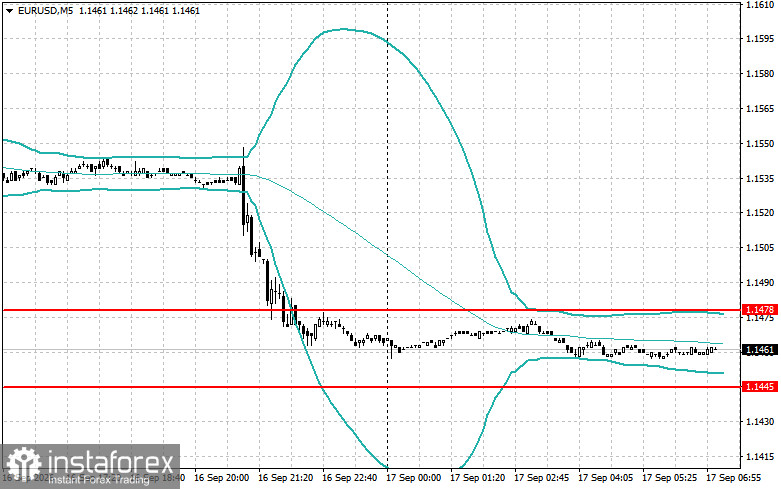
For the euro, I'm watching the upper boundary at 1.1478. The logic is simple: the pair pokes above, fails to find continuation buyers, and then slides back down — that gives a sell signal. After yesterday's Fed decision, this scenario looks appropriate, since market participants will need a very strong reason to ignore the Fed's markedly increased resolve. The lower reference 1.1445 works by the opposite logic, but buy there with caution — trading against the dollar immediately after such a hawkish Fed decision is not easy, and targets for such a rebound should be modest.
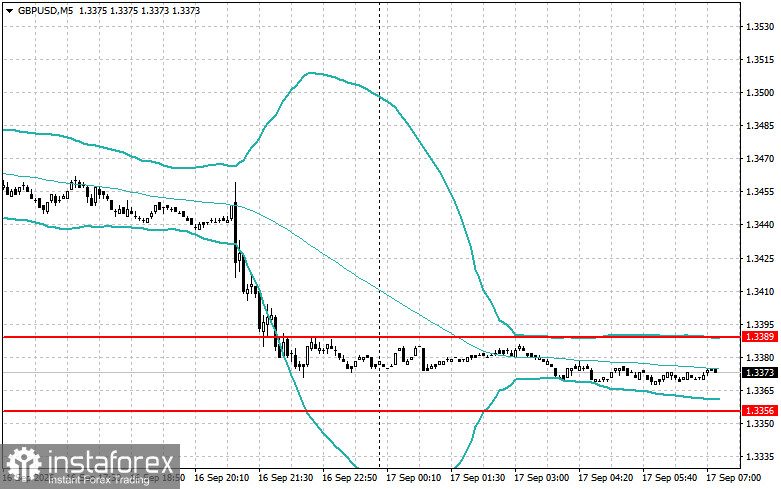
For the pound, the upper boundary is 1.3389. The same return logic applies: a move above without follow-through is a sell signal, and given the double pressure on the currency today, that outcome looks plausible. The lower reference 1.3356 implies buying on a rebound after a false downside break, but trade it cautiously and in the context of the BoE outcome — if the BoE's tone is softer than expected, even a successful technical bounce may be short-lived before the pair resumes downward.

