
यह भी देखें


 07.09.2026 10:09 AM
Iran and the United States exchanged the largest tanker strikes in recent times over the weekend, pushing oil prices higher. Brent rose 0.4 percent on Monday and trades near a late-July high, remaining above $97 per barrel.
Tehran said it struck three US-linked vessels that were transiting the Strait of Hormuz on unauthorized routes, in response to American strikes on Iranian tankers. US military officials earlier reported strikes on three Iranian oil tankers, one of which was destroyed, as retaliation for ballistic-missile attacks on two US Navy ships by the Islamic Revolutionary Guard Corps.
But the most telling figure in this story is not a price: according to Kpler, only one commercial vessel passed through the Strait of Hormuz on Saturday. Observed traffic remains extremely sparse, which means the strait — once carrying about one-fifth of global oil and LNG shipments — is effectively closed as a transit artery.
The causal chain from strikes to prices works directly and with little delay here. Attacks on tankers raise insurance premia and make passage economically pointless for shipowners, traffic collapses, physical shipments from the Gulf fall, and the market prices in a deficit. Winners include US shale producers and exporters outside the region, whose oil is now worth more at no extra cost, and tanker owners earning from surging freight rates. Losers are Gulf producers cut off from buyers, Asian importers and European consumers for whom pricier fuel becomes inflation.
Rhetoric from both sides indicates neither is ready to back down. Iranian parliament speaker Mohammad-Bagher Ghalibaf, who once led ceasefire talks, declared an end to the era of proportional responses: "The US must understand, before it is too late, that the rules of the game have changed," he said, adding that any aggression against Iran's interests or security will receive "a faster, heavier and more painful response." US energy secretary Chris Wright said American naval presence will continue: "This should not be the responsibility of the United States alone, but until Iran changes course or changes its government, we will have to deal with them," he said on CNN.
The market's greatest worry is an announcement by Iran's top security official, Mohsen Rezaei: he said that in the coming days a new exclusion zone outside the Strait of Hormuz will be declared, starting from the line of the US maritime blockade and extending into parts of the Persian Gulf. Geography matters here: until now, the conflict has focused on the narrow throat of the strait, while expanding the zone into the Gulf affects waters that host Saudi, Kuwaiti, Iraqi, and UAE export terminals.
What happens if escalation continues at the current pace? I am convinced the key tipping point will be the exclusion zone rather than the number of tanker strikes. While Gulf producers currently shuttle barrels with transponders off, the market remains short of supply but not paralyzed. Expansion of the zone to terminals would shift the situation from constrained transit to blocked production, and that scenario would push prices far beyond the current range.
Also notable is the gap between Washington's rhetoric and reality. Trump on Friday called the conflict "small," and Vice President J.D. Vance said he would not call it a war. Yet 18 US service members have died over six months, munitions are being consumed, and polls show weak approval of presidential actions — a political domestic factor that could make Republicans risk losing control of Congress in the November midterms. It seems to me this domestic political constraint, more than military exhaustion, will limit US escalation as November approaches.
I expect that if escalation continues at the present pace, Brent will hold in a $100–$110 per barrel range through the end of September, and refined-product markets will move even further ahead because US diesel margins have already hit record territory.
A declared exclusion zone that actually cuts off part of the Gulf could send prices to $130 within a few sessions. I do not rule out the opposite scenario either, where the approach of midterm elections forces Washington to seek a quick resolution, and prices snap back toward $80 just as quickly.
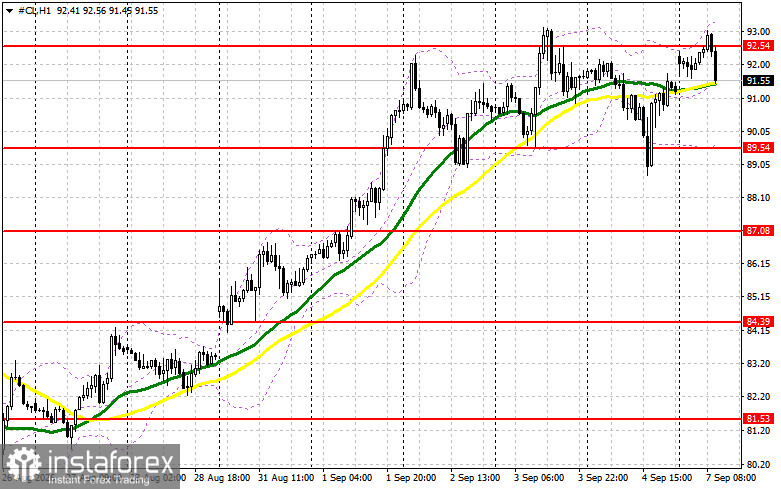
Regarding the current technical picture for oil, buyers need to reclaim the nearest resistance at $92.50. That would allow targeting $96.54, above which a breakout would become rather difficult. The most distant target is in the $100.40 area. If oil falls, bears will try to take control of $89.54. If they succeed, a break of that range would deliver a serious blow to bulls and push Oil toward the $87.08 low, with a further prospect of reaching $84.40.

