
यह भी देखें


 23.07.2026 07:00 PM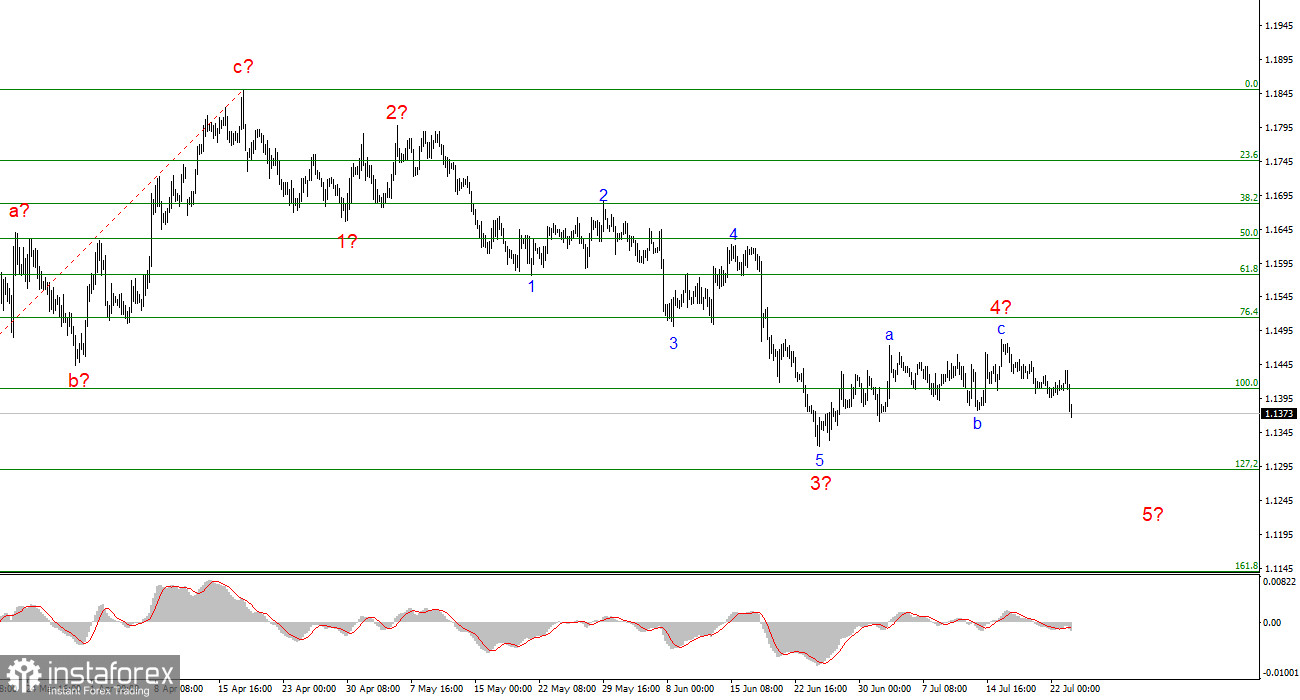
The 4-hour Elliott Wave structure for EUR/USD is becoming increasingly complex. There is still no indication that the upward trend segment (shown in the lower chart), which began in January of last year, has been invalidated. However, the current wave structure has taken on a corrective form.
From a long-term perspective, the formation of wave C is expected, with its low ideally positioned below the low of wave A. At present, the low of wave C has already moved below the low of wave A, meaning that wave C could be completed at any time. However, if the fundamental backdrop becomes more favorable for the US dollar, this wave could extend further.
On the lower timeframe, I can identify a classic five-wave downward structure. If this assumption is correct, wave 4 is currently developing, while wave 3 has taken a five-wave form. Once this structure is complete, the pair may begin forming a new upward wave sequence.
However, according to the current wave count, another downward wave—wave 5—is still expected. Therefore, the euro could decline toward the 1.1300 level or even lower.
ECB Does Not Surprise the Market
EUR/USD declined by 50 basis points on Thursday, and from the perspective of the news background, this move appears difficult to explain. The ECB decided to leave interest rates unchanged and wait until its next meeting to reassess developments in the Middle East conflict, oil and gas prices, and inflation trends.
This decision was exactly what market participants had expected, meaning the European regulator did not provide any surprise. Therefore, the sharp sell-off in the euro was not caused by the ECB meeting. There were also no other significant events during the day.
So, what happened?
I have previously noted that wave analysis often conflicts with fundamental developments. Sometimes news events prevail, and sometimes technical structures dominate. Unfortunately, it is never possible to have complete certainty about any scenario.
Today, it can be said with confidence that the waves prevailed. EUR/USD sharply resumed its decline and may soon break below the low of the projected wave 3 of C. After that, the downward trend structure would take on a completed form.
The low of wave 5 of C does not necessarily need to be significantly below the low of wave 3 of C. It could end only a few dozen points lower. Given that the fundamental backdrop is not disastrous for the euro and not exceptionally favorable for the dollar, I cannot rule out the possibility that the euro's decline may be nearing its end.
If this scenario proves correct, the formation of a new upward trend segment could begin from the 1.1300 level. Initially, this move would be considered corrective, but any corrective structure can eventually develop into an impulsive trend.
Much will depend on geopolitical developments. If the conflict in the Middle East continues and both key shipping routes remain blocked, market participants may conclude that the US dollar deserves renewed buying interest.
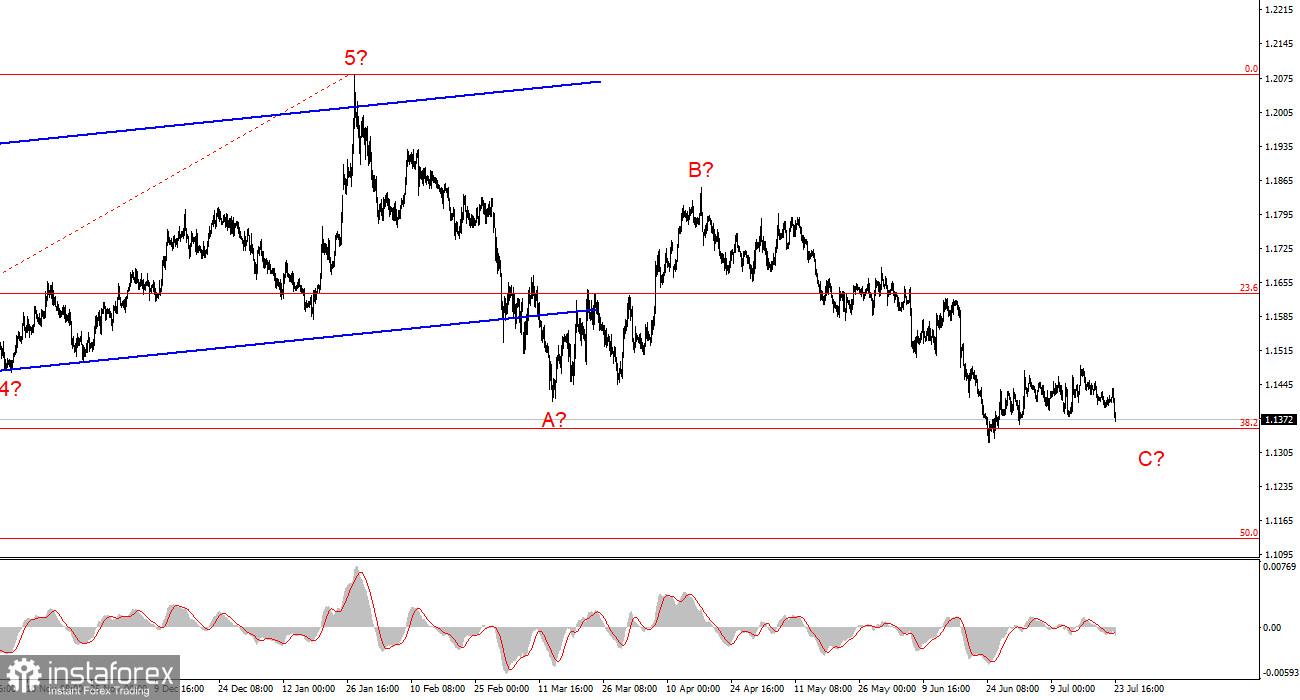
Based on the EUR/USD analysis, I conclude that the pair remains within the broader upward trend structure (shown in the lower chart), while in the shorter term it remains within a downward correction.
In my view, the current levels may provide an opportunity to begin considering long positions. However, the pair could still decline toward the 1.1300 level as part of wave 5 of C. Wave analysis often produces unexpected outcomes, so I would already begin preparing for potential buying opportunities.
On the higher timeframe, the upward trend structure remains visible, followed by the development of a corrective wave sequence. In the near term, wave C is expected to form, with targets around 1.1352, corresponding to the 38.2% Fibonacci retracement level.
Once the A-B-C corrective structure is complete, a new long-term bullish trend may begin.
Main Principles of My Analysis

