
यह भी देखें


 14.07.2026 06:47 PM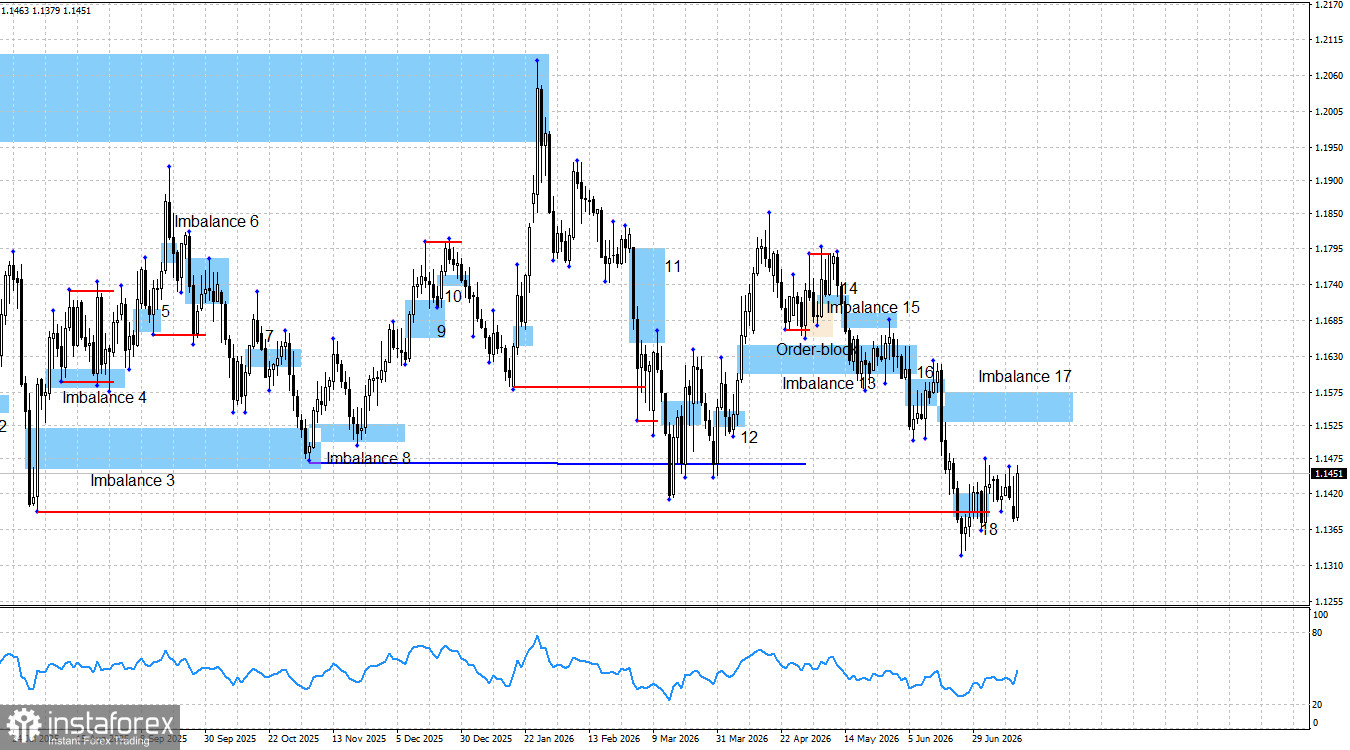
The EUR/USD pair remains within a local bearish impulse, although over the past two weeks the bulls have managed to push the bears back. However, the euro's gains during this period have been so modest that they are barely visible on the charts. Nevertheless, the bulls have mounted a certain degree of pressure, and the euro's near-term prospects (at least for this week) will depend on geopolitics, inflation, and Kevin Warsh's stance. Thus, these three factors will determine trader sentiment this week.
The first of these factors has already become clear and has supported the bulls. It was announced today that US inflation slowed to 3.5% year-on-year, rather than the 3.8% expected by the market, significantly reducing the likelihood of FOMC monetary tightening. I do not believe this means that the Federal Reserve will abandon the idea of raising interest rates, but inflation has nevertheless slowed by 0.7 percentage points in just one month. Kevin Warsh, Chair of the Federal Reserve, is also scheduled to speak later today. In my view, his rhetoric is unlikely to differ from that of the Fed's press conference a month ago, and he will continue to emphasize the need to bring inflation down. At the same time, this does not necessarily mean that the Fed will tighten monetary policy this month.
It is also worth recalling that the latest US labor market data showed that inflation is not the only indicator that deserves attention. Job creation remains relatively weak. Over the past three months, the number of jobs added has been approximately 100,000 lower than traders had expected. Therefore, the slowdown in the US labor market may force the FOMC to weigh any decision on monetary tightening much more carefully.
Geopolitics has moved into the background because of the Fed. Last week, Tehran and Washington once again violated the terms of the ceasefire and the June 17 agreement, but this came as no surprise to traders. Donald Trump signed an order revoking authorization for Iranian oil exports, while Iran once again blocked the Strait of Hormuz and continued firing on vessels attempting to pass through it. The market did not react when the conflict effectively came to an end, so it should not be expected to react strongly to its renewed escalation. We did not see the widely anticipated decline in the US dollar as geopolitical tensions eased, nor did we see the euro strengthen following the ECB's monetary tightening. The bears remain in control despite the broader news flow and geopolitical backdrop. Now that geopolitical tensions have once again become a source of disappointment, the bears have at least formal grounds to launch new attacks. In my opinion, however, traders are already pricing in events for the third time that have not yet actually occurred.
The current technical picture continues to point to the preservation of the bearish impulse that began on April 17. Bearish imbalance 17 has not yet been tested, while imbalance 18 has been invalidated following weak US labor market data. No bullish patterns have formed, and they are unlikely to appear over the next few days, as the market is largely moving sideways. Therefore, the bulls may continue a corrective advance toward imbalance 17, but there is currently no clear technical basis for trading this move. I would also note that liquidity has been swept below the August 1 low from last year (the red line on the chart). At present, this signal remains the bulls' only meaningful source of support and hope.
Tuesday's economic backdrop proved fairly interesting. So far, the inflation report has been released, coming in below expectations and providing support for bullish traders. Kevin Warsh is also scheduled to testify before the US Congress later today.
There are still numerous reasons for the bulls to remain active in 2026, and even the conflict in the Middle East has not diminished them. From both a structural and a long-term perspective, Trump's policies, which triggered a significant decline in the US dollar last year, have not changed. At present, I do not see any major factors capable of providing sustained support for the US currency, despite the FOMC's hawkish stance. The EUR/USD pair is approaching a series of significant lows and swing points where liquidity could be swept, potentially signaling a reversal of the current bearish impulse.
The economic calendar for July 15 includes three scheduled events, one of which can be considered important. As a result, the economic backdrop may influence market sentiment during the second half of Wednesday's trading session.
In my view, the pair remains in the process of forming a bullish trend. Although the fundamental backdrop shifted sharply in favor of the bears four months ago, the broader trend cannot yet be considered cancelled or complete. Therefore, the bulls may launch a new advance after liquidity is swept below clearly defined lows. However, opening long positions at the current stage is not advisable. It is better to wait until bullish patterns emerge first.
At present, traders have two bearish imbalances available, one of which has already been invalidated. I would also draw attention to the proximity of four significant swing points where liquidity sweeps could occur, as well as to the questionable fundamental basis for the recent strength of the US dollar. Therefore, I continue to expect a bullish advance, but it is essential to obtain at least some technical confirmation of this scenario. Otherwise, it would be more prudent to wait for a new sell signal to form within imbalance 17.

