
यह भी देखें


 09.06.2026 04:14 AM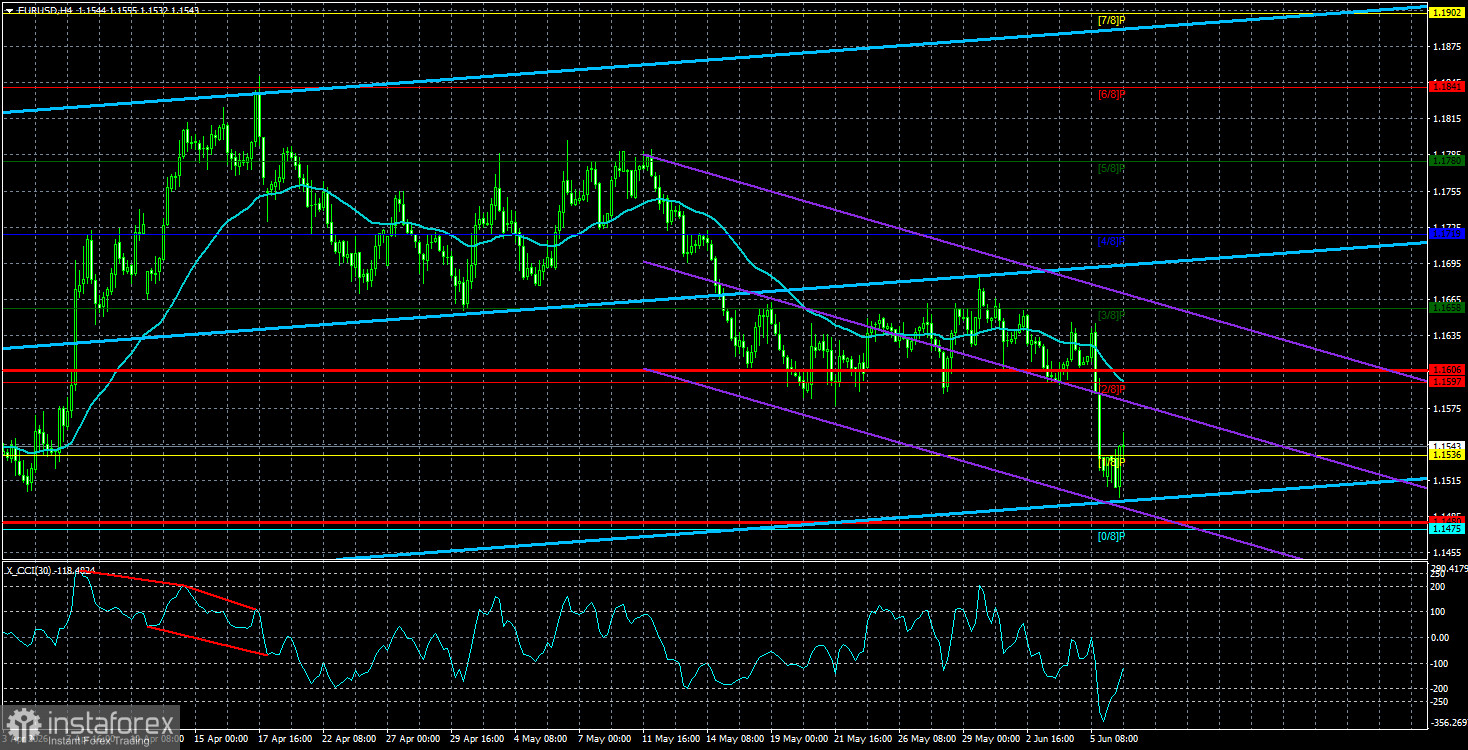
The EUR/USD currency pair traded quite calmly on Monday, with the U.S. dollar failing to extend Friday's momentum, and volatility once again fell to minimal levels. Despite a steady stream of geopolitical news, traders are still hardly reacting to it. On Monday, it became known that Iran launched rocket strikes against Israel, marking the first such attacks since the ceasefire agreement came into effect in early April. Thus, it's time to talk about the escalation of the conflict and the resumption of war rather than expecting a ceasefire anytime soon.
However, as mentioned, the market hardly reacted to this new violation of the temporary ceasefire in the Middle East, as it essentially does not affect anything. The parties to the conflict still cannot agree on a deal, and negotiations continue despite regular shelling from both "rebels," with the Strait of Hormuz remaining blocked. Therefore, one more strike or one less does not matter. In general, the market has reacted only to one event in the past three weeks—the NonFarm Payrolls report released on Friday. This report did indeed show positive figures, indicating not only a recovery in the U.S. labor market but also allowing the Federal Reserve to move faster toward inflation containment.
We doubt that the tightening of the Fed's monetary policy is a foregone conclusion by the end of the year, as we still do not know what position new chair Kevin Warsh will take and how he will influence the entire FOMC. Therefore, we would not rush to conclusions. However, the fact remains—a hawkish sentiment is strengthening in the market, which could further support the American currency.
This sentiment may grow stronger this week, as the May inflation report will be released on Wednesday, and the index may show a third consecutive acceleration, this time to 4.2%. This will be yet another reason for the Fed to tighten monetary policy faster than the market currently anticipates. Thus, geopolitics is clearly on the dollar's side at the moment, and key indicators influencing the Fed's monetary policy are also in the dollar's favor.
We do not expect significant growth for the American currency in 2026, but in the first half of the year, almost everything is falling in its favor. Modest growth for the U.S. dollar is possible, but in the long term, any increase in the currency will be a correction. Let's remember that Bitcoin corrected for three months before the new decline, and many traders did not believe in a new crash. However, the correction ended, and Bitcoin fell again. The same could happen with the dollar. It may continue to correct for another six months, but the global fundamental backdrop still points to a rather cloudy future for the greenback.
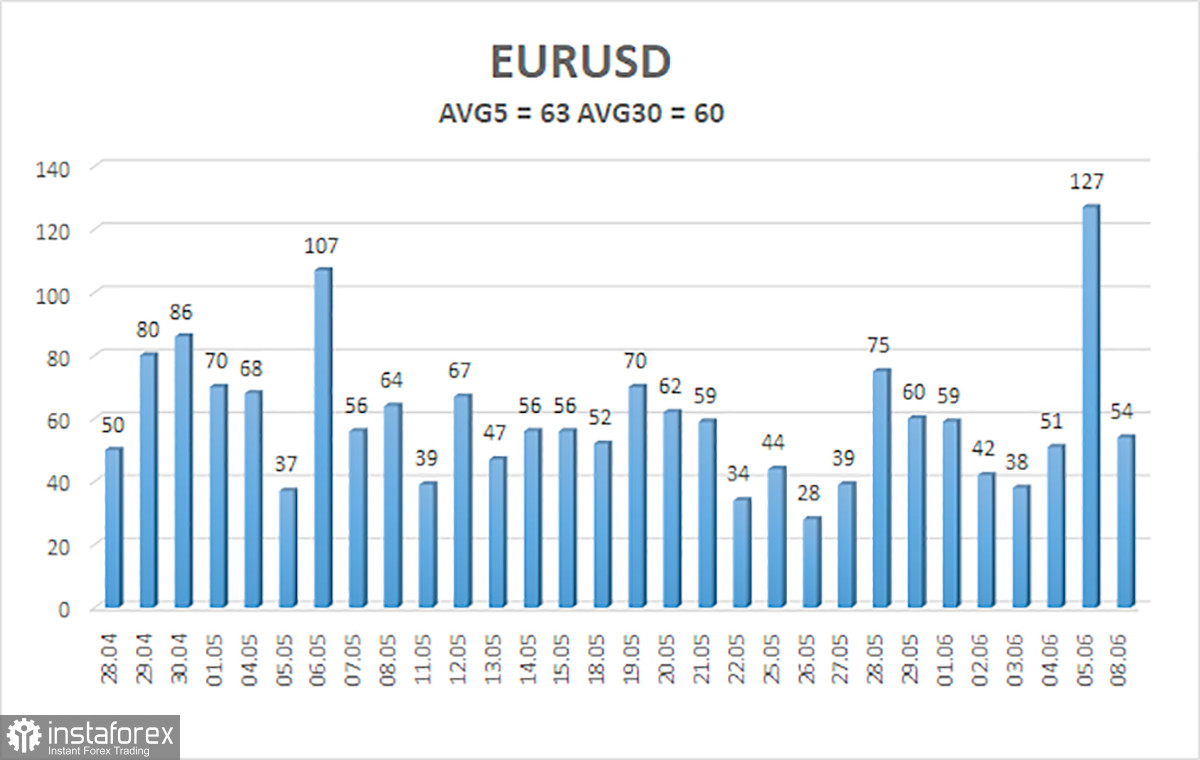
The average volatility of the EUR/USD currency pair over the past five trading days, as of June 9, is 63 pips, which is considered "average." We anticipate that the pair will move between levels 1.1480 and 1.1606 on Tuesday. The upper channel of the linear regression has turned upward, indicating a trend change to bullish. The CCI indicator has entered the overbought zone and has formed two "bearish" divergences, warning of the onset of a downward correction that is still not complete. On Friday, it entered the oversold zone, warning of a possible end to the correction.
S1 – 1.1536
S2 – 1.1475
S3 – 1.1414
R1 – 1.1597
R2 – 1.1658
R3 – 1.1719
The EUR/USD pair continues its downward movement, presumably a correction within the context of a global upward trend. The global fundamental backdrop for the dollar remains extremely negative, with only the geopolitical factor regularly supporting it. For prices located below the moving average, shorts may be considered with targets at 1.1480 and 1.1475. Above the moving average line, long positions are relevant with targets at 1.1719 and 1.1780. The market continues to pull away from geopolitical factors, but in recent weeks, the dollar has been in demand as hopes for peace in the Middle East have weakened.
Linear regression channels help determine the current trend. If both are directed in the same direction, the trend is strong;
The moving average line (settings 20,0, smoothed) determines the short-term trend and the direction in which trading should be conducted;
Murray levels are target levels for movements and corrections;
Volatility levels (red lines) are the probable price channels within which the pair will stay for the next 24 hours, based on current volatility indicators;
The CCI indicator entering the oversold zone (below -250) or the overbought zone (above +250) indicates an approaching trend reversal in the opposite direction.

