
यह भी देखें


 13.02.2026 09:14 AM
Yesterday's US labor market and housing data did little damage to the US dollar, which rose sharply amid a sell-off in equities and gold.
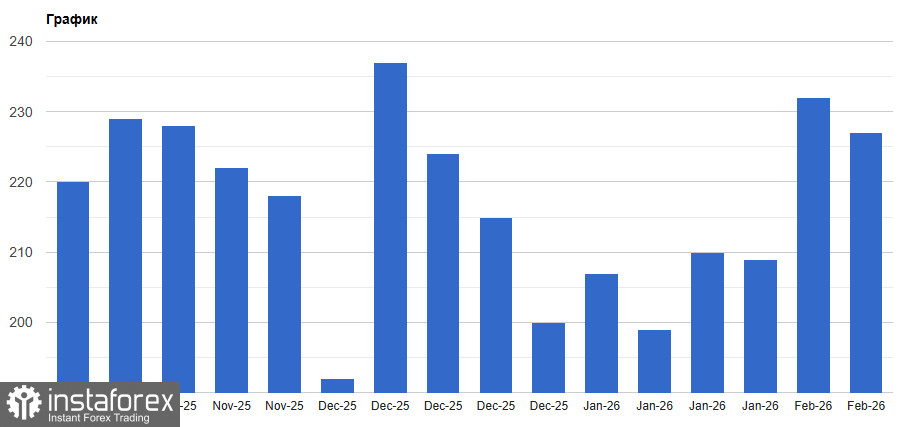
The US Labor Department said initial jobless claims last week fell slightly after a sharp rise during severe winter weather in the prior period. According to the data, initial claims decreased by 5,000 to 227,000 for the week ended February 7. Economists had forecast a decline to 223,000.

Continuing claims for unemployment benefits for the prior week rose to 1.86 million.
Weekly jobless claims typically fluctuate around holiday periods and during severe weather, when people are temporarily unable to work. A lower level of claims indicates that businesses and schools largely resumed activity last week after the severe winter storm that swept the country.
Data published on Thursday also indicated there has not been a material rise in layoffs recently, despite job-cut announcements from large companies. The lower level of unemployment claims, together with other indicators, suggests those announced reductions have not yet translated into mass job losses.
Recall that the most recent government employment report showed January was the strongest month for job growth in more than a year and that the unemployment rate fell.
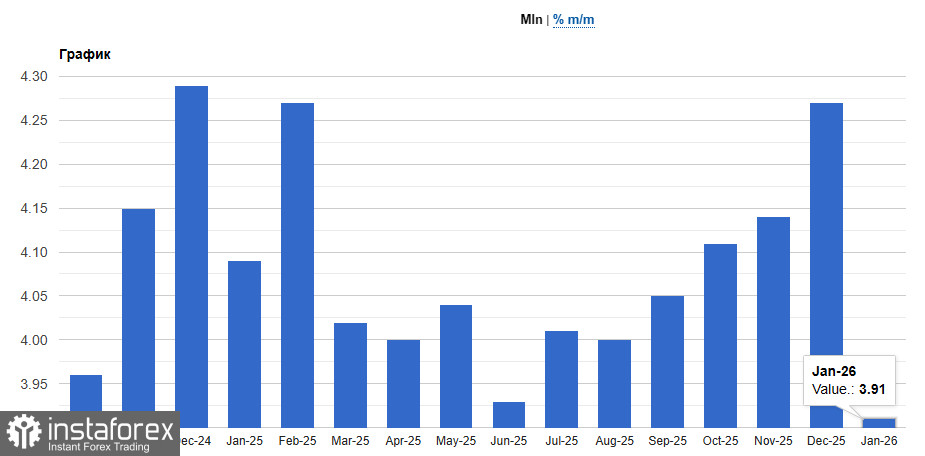
On the housing market, data from the National Association of Realtors published on Thursday showed existing home sales fell 8.4% — the largest monthly drop since February 2022. Sales slowed to a 3.91 million annualised pace, well below the consensus forecast.
The association said the severe winter storm in late January, which blanketed much of the United States with snow and ice, likely delayed many closings. The NAR said that low temperatures and elevated precipitation in January made it difficult to assess the underlying causes of the decline and to determine whether that month's figures were an anomaly.
One positive factor for the housing market is a modest improvement in affordability: mortgage rates have eased recently, and affordability measures rose to their highest since 2022, though they remain well below pre-pandemic norms. Prices responded quickly to lower rates by ticking up.
As noted above, the currency market reacted only modestly to the releases.
A technical outlook for EUR/USD suggests that buyers should consider reclaiming 1.1890. That would open the way to test 1.1925. From there, a move to 1.1957 is possible, although advancing beyond that without support from major players would be difficult. The extended target is 1.1994. On a decline, meaningful buying interest is likely near 1.1850. If buyers do not appear there, it would be prudent to wait for a new low at 1.1830 or to open long positions from 1.1800.
As for GBP/USD, buyers of the pound sterling should capture the nearest resistance at 1.3620. Only that will allow them to target 1.3640, above which a breakout would be challenging. The extended target is around 1.3665. If the pair falls, bears will try to seize control at 1.3600. If they succeed, a break of that range would deal a serious blow to bullish positions and could push GBP/USD down to 1.3570 with scope to extend to 1.3545.

