
यह भी देखें


 06.02.2026 07:32 PM
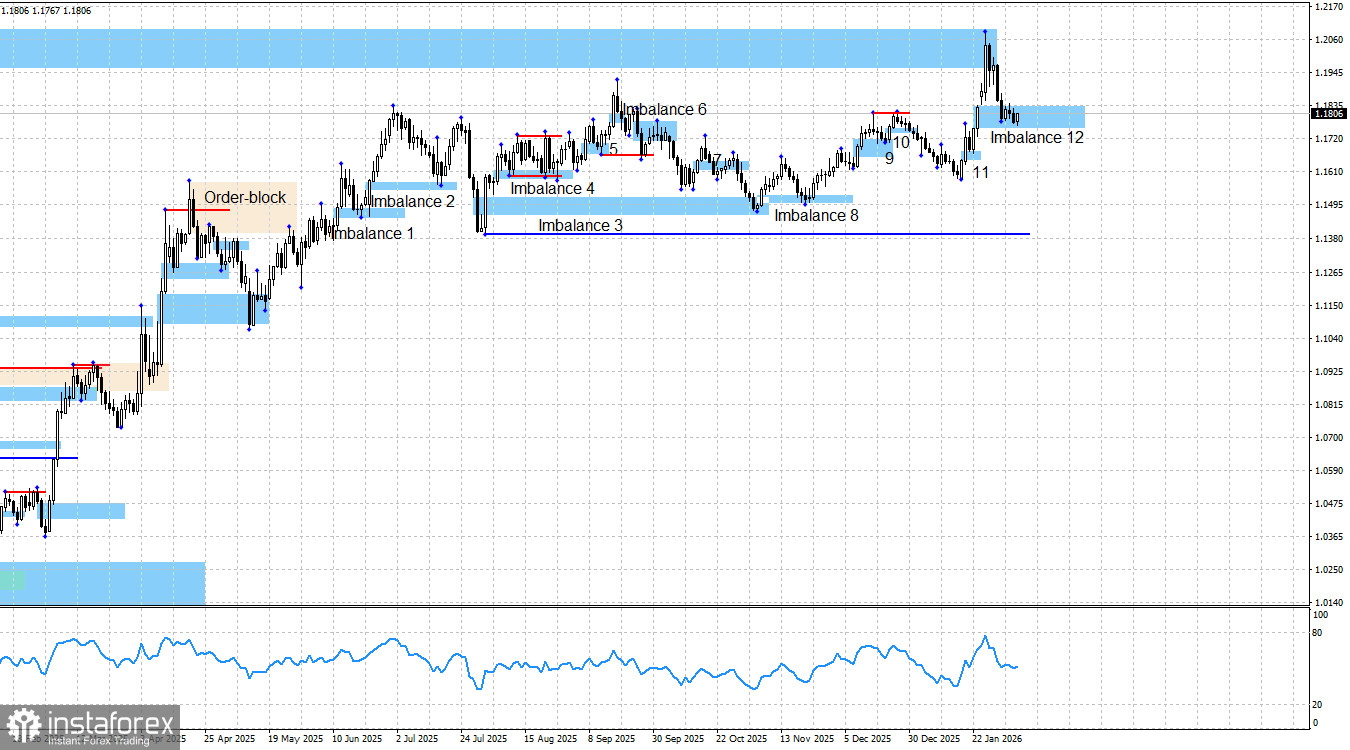
The EUR/USD pair has returned to the "bullish" imbalance 12, and traders are now anxiously awaiting the outcome. Both currency pairs (EUR/USD and GBP/USD) are positioned in such a way that they may resume a bullish trend (which would be entirely logical) from both a technical and economic perspective. However, invalidation of the bullish imbalances in the euro and the pound would lead to a decline that I would not recommend traders attempt to trade. Such a scenario would complicate the current picture and force the market to wait for the formation of new bullish patterns and corresponding signals.
Expectations for the current week were very high, but in practice traders received little more than nothing. Today, the ECB made no important decisions and did not signal an imminent easing of monetary policy. US labor market data were limited to two relatively minor reports. The Bank of England arguably complicated the outlook for the pound rather than providing a clear impulse, having made a "neutral" interest rate decision by a very narrow margin. Nevertheless, both currency pairs remain in a solid bullish position.
The technical picture continues to signal bullish dominance. The bullish trend remains intact. A bullish signal was formed in imbalance 11, followed shortly by a new imbalance 12. Traders should now expect either a new buy signal within imbalance 12 or an invalidation of this pattern. The EUR/USD pair is currently at a crossroads: either the trend will logically continue, or it will be put on pause.
The news background on Friday was unremarkable. Industrial production in Germany once again declined, as has become customary, and no other reports have been released so far. However, a day earlier, the US JOLTS report on job openings for December was released unexpectedly and showed a figure that indirectly confirms a negative outlook for the US labor market following the ADP report. The number of job openings amounted to just 6.5 million, versus market expectations of 7.2 million. The labor market is facing serious structural problems due to Donald Trump's policies, and I do not observe any signs of recovery.
Bulls have had plenty of reasons for a renewed offensive for the past six to seven months, and each week their number only increases. These include the (in any case) dovish outlook for FOMC monetary policy, Donald Trump's overall policy (which has not changed recently), the US–China confrontation (where only a temporary truce has been reached), protests by the American public against Trump under the banner of "No kings," labor market weakness, the autumn government shutdown (which lasted a month and a half), and a new shutdown at the beginning of February. Added to this are US military aggression toward certain countries, criminal proceedings against Powell, the "Greenland confusion," and escalating tensions with Canada and South Korea. Thus, in my view, further growth of the pair would be entirely logical.
I still do not believe in a bearish trend. The information background remains extremely difficult to interpret in favor of the dollar, which is why I do not attempt to do so. The blue line shows the price level below which the bullish trend could be considered over. Bears would need to push the price down by about 400 points to reach it, and I consider this task impossible under the current information backdrop and circumstances. The nearest upward target for the European currency was the bearish imbalance at 1.1976–1.2092 on the weekly chart, which was formed back in June 2021. This pattern has now been fully filled. Above that, only two levels stand out: 1.2348 and 1.2564. These levels represent two peaks on the monthly chart.
News calendar for the US and the Eurozone:
On February 9, the economic calendar contains no noteworthy events. The influence of the news background on market sentiment on Monday will be absent.
EUR/USD forecast and advice for traders:
In my view, the pair remains in the process of forming a bullish trend. Despite the fact that the information background continues to favor bulls, bears have regularly launched attacks in recent months. Nevertheless, I see no realistic reasons for the start of a bearish trend.
From imbalances 1, 2, 4, 5, 3, 8, and 9, traders had opportunities to buy the euro. In all cases, we observed some growth, and the bullish trend remained intact. Last week, a new bullish signal was formed from imbalance 11, once again allowing traders to open long positions with a target of 1.1976. That target was reached. Later, another bullish imbalance, 12, was formed, and in the near future traders may receive a new opportunity to buy.

