
Lihat juga


 07.09.2026 06:40 PM
The EUR/USD pair declined for six days, but the bears' advance has now come to an end. For six full days, the U.S. dollar has been unable to convince traders of the merits of further purchases. Imbalance 21 has not been invalidated, while Imbalance 20 triggered a price reaction. The only factor that somewhat weakened the bullish picture was the Nonfarm Payrolls figure, which, after a series of weak labor market and business activity reports, showed a genuinely strong result. A total of 162 thousand new jobs were created in August, while traders had not expected more than 56 thousand. It does not matter that this figure could be revised significantly lower a month from now. Thus, the Nonfarm Payrolls report should have triggered a very strong rise in the U.S. currency. This is not only because the labor market itself finally showed a positive result, but also because the chances of FOMC monetary policy tightening have now increased. I certainly do not want to draw conclusions about the state of the labor market based on a single report for one month, but ahead of the September meeting, it nevertheless provides a good basis for a rate hike. However, I still believe that the Fed will not take a hawkish step in September. This may explain the market's muted reaction to the payrolls report.
Overall, in my view, the information background continues to fully support the bulls. First, any chart clearly shows that the European currency began its rise from relatively low levels, compared with its average price over the past year. This means that it still has upward potential. Second, the market continues to question FOMC monetary policy tightening in September, regardless of what W. Warsh says. Third, economic data from the United States have recently brought nothing but disappointment. Fourth, geopolitics is no longer supporting the bears or the dollar. Fifth, the ECB may implement another round of monetary policy tightening this autumn. Sixth, the U.S. Treasury has decided to increase purchases of long-term bonds, which reduces demand for the dollar. Seventh, a new trade war could begin in the near future between the United States and Canada and between the United States and China. Eighth, the U.S. labor market is contracting, which could put an end to Warsh's hawkish initiatives. Thus, I currently see no reason whatsoever for a bearish advance.
U.S. labor market data over the past 4–6 months have more often been weak than strong, inflation has slowed over the past 2 months, while GDP growth has decelerated over the past three quarters. These three factors make me question FOMC rate hikes not only in September but also through the end of the year. In my view, the bears' only opportunity at present lies in a new escalation in the Middle East, rather than in individual economic reports.
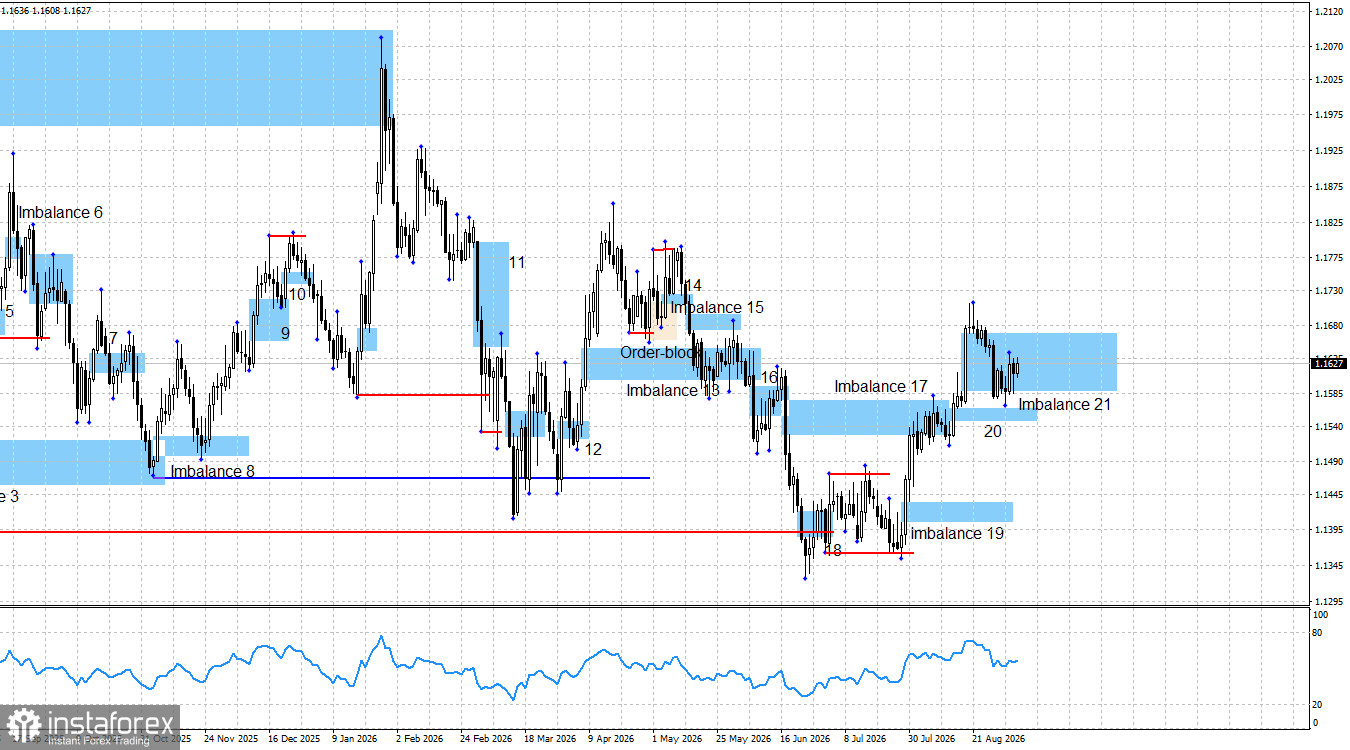
The current chart structure indicates that the bullish momentum is being maintained. Price has completely filled the latest bullish Imbalance 21 and even touched the previous bullish Imbalance 20. The combined reaction to these two patterns could bring the bulls back into the market and resume the upward move. The bears will gain chart-based grounds for an advance only if both patterns are invalidated. The European currency will also have to save the pound, which does not have such a strong support zone.
The economic background on Monday allowed the bulls to launch a new attack, as the Eurozone Q2 GDP report came in stronger than expected. However, the picture was weakened for the bulls by the German industrial production report, which declined another 1.1% m/m.
There are still a huge number of reasons for the bulls to attack in 2026, and even the outbreak of war in the Middle East has not reduced their number. Structurally and globally, Trump's policies, which led to a significant decline in the dollar last year, have not changed. At present, I see no serious factors supporting the U.S. currency, despite the FOMC's formally hawkish stance. Geopolitics, which supported demand for the U.S. currency during most of the first half of 2026, is no longer doing so. The conflict in the Middle East remains unresolved, but there are currently no new military actions by either Iran or the United States.
News Calendar for the United States and the European Union:
On September 8, the economic events calendar contains two releases, neither of which is of particular interest. The impact of the economic background on market sentiment on Tuesday will be weak or absent.
EUR/USD Forecast and Trading Tips:
In my view, the pair remains in the process of forming a bullish trend that took a pause for an entire year. The information background changed sharply in favor of the bears six months ago, but the trend itself cannot be considered canceled or complete. In the long term, I would say that the pair is moving within a range. However, the range does not invalidate the broader bullish trend. Thus, the bulls may well continue their advance after two liquidity sweeps from clearly defined lows. At present, bullish traders have an excellent support zone in the form of Imbalance 21, where a new bullish signal may form. We have already seen a precise rebound from Imbalance 20. As targets for a new rise in the European currency, I consider the levels of 1.1797 and 1.1850.


