
See also


 23.07.2026 07:31 PM
A few hours ago, the European Central Bank (ECB) concluded its fifth monetary policy meeting of 2026. The outcome came as no surprise to market participants.
To briefly recap the recent backdrop, eurozone inflation accelerated to 3.2% in May, prompting the ECB to tighten monetary policy. However, in June, consumer inflation slowed to 2.8% as oil prices retreated to their pre-conflict levels, giving policymakers more room to pause.
As of today, oil prices have climbed back above $100 per barrel, raising the possibility that inflation could accelerate again in July. However, given how quickly developments are unfolding in the Middle East, it would not be surprising if President Donald Trump and Iran were to reach another ceasefire before the end of the month, reopen the Strait of Hormuz, and resume nuclear negotiations.
If that scenario materializes, oil prices could fall again, inflationary pressures would likely ease, and the ECB would have little reason to rush into a second round of monetary tightening. For better or worse, geopolitical developments are currently the dominant driver of the outlook.
What Did the ECB Decide?
According to ECB President Christine Lagarde, policymakers did discuss the possibility of raising interest rates at the July meeting but ultimately decided against it.
All three key interest rates were left unchanged with unanimous support from the Governing Council.
Lagarde explained that policymakers preferred to wait until September to confirm whether tighter monetary policy would be warranted, when the outlook for energy prices and inflation should become clearer. She identified GDP growth, inflation, and both the manufacturing and services Purchasing Managers' Indices (PMIs) as the key indicators that will guide future policy decisions.
Lagarde also stressed that the ECB has no predefined path for monetary policy. Interest rate decisions will continue to be made on a meeting-by-meeting basis, depending entirely on incoming economic data.
The ECB will publish updated forecasts for economic growth and inflation in September, and those projections will play a central role in determining the next policy decision.
At the same time, the ECB president acknowledged that inflation risks are once again shifting to the upside, potentially forcing the central bank to raise interest rates for a second time this year.
These risks are primarily linked to the renewed conflict in the Middle East and the actions of the Houthi movement in the Red Sea. It is worth noting that the Houthis have begun targeting Saudi oil tankers, although the Bab el-Mandeb Strait has not been fully blocked. At present, the disruption affects only Saudi shipping.
EUR/USD Wave Outlook
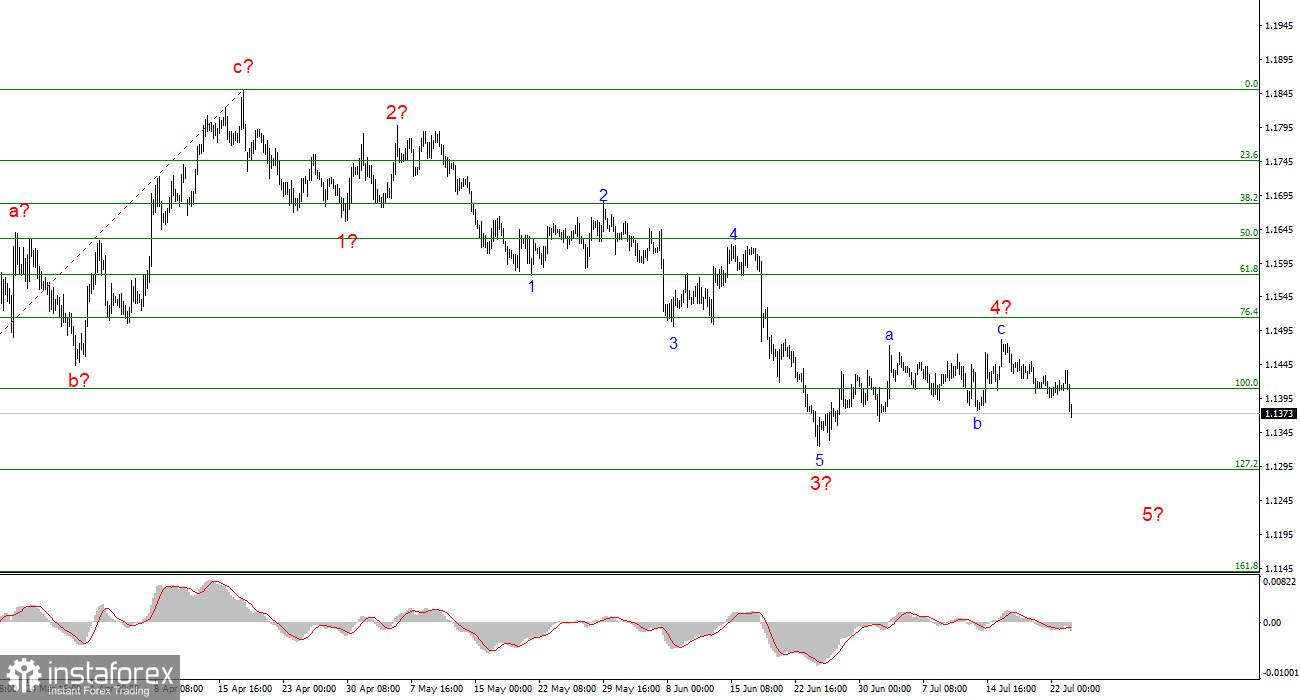
Based on my wave analysis, EUR/USD remains within a broader long-term uptrend (see the lower chart), while the shorter-term trend remains corrective and bearish.
In my opinion, current price levels may present an opportunity to begin preparing for long positions. However, the pair could still decline toward the 1.1300 level as part of wave 5 of C. Wave structures often evolve unexpectedly, so I would already begin shifting my focus toward potential buying opportunities.
GBP/USD Wave Outlook
The wave structure of GBP/USD has become considerably more complex.
At present, the pair has completed three downward waves, whereas EUR/USD may still develop a full five-wave decline. Consequently, GBP/USD could produce one additional downward wave, but that move may represent only the second wave within a new bullish trend.
As a result, the differences between the EUR/USD and GBP/USD wave counts are likely to remain relatively minor and should not materially alter the broader outlook.
Accordingly, I expect another short-term pullback, followed by the formation of a new upward trend, with the initial upward targets located in the 1.3700-1.3800 level.
Key Principles of My Analysis
Wave structures should remain simple and easy to interpret. Complex wave patterns are difficult to trade and frequently change.
If the market outlook is unclear, it is often better to stay on the sidelines.
There is never complete certainty about market direction. Always use protective Stop Loss orders.
Wave analysis can be combined with other forms of technical analysis and trading strategies.


