
See also


 23.07.2026 07:00 PM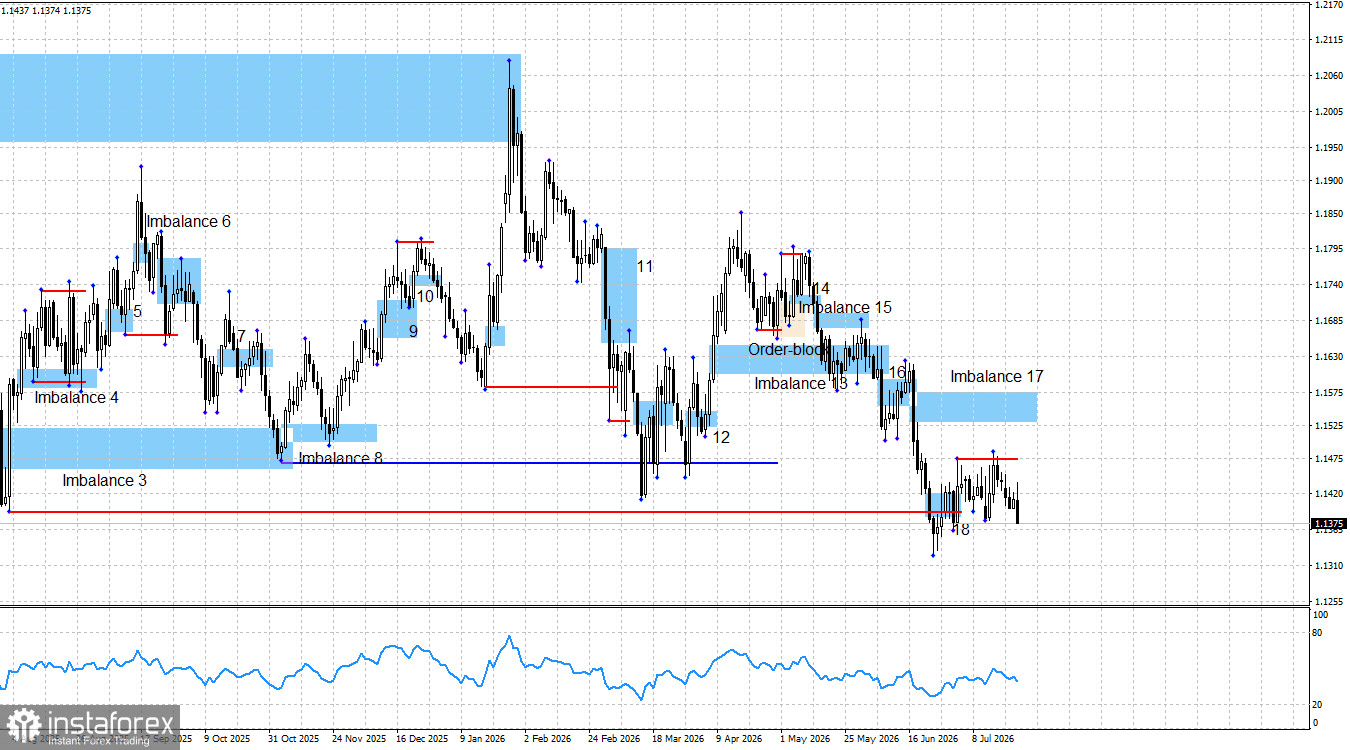
EUR/USD remains within the local bearish impulse that began on April 17. Over the past three weeks, buyers have managed only a modest recovery, showing little conviction. While bulls did attempt to regain control, their advance lacked momentum. Today marks the sixth consecutive day of renewed weakness in the euro, highlighting the limited strength displayed by buyers in recent weeks.
The latest liquidity sweep pointed to a high probability that the downtrend would resume. It is difficult to estimate how deep or prolonged the next decline may be, but sellers have one obvious downward target—the recent swing low at 1.1325. Liquidity may also be taken below that level, potentially providing bulls with another opportunity to regain control.
As for the fundamental backdrop, I still see little justification for the bears' persistent strength. Geopolitical developments have deteriorated again, but they are unlikely to be the primary driver, given that markets barely reacted to the temporary ceasefire or the reopening of the Strait of Hormuz. Meanwhile, the European Central Bank left monetary policy unchanged today—but it is difficult to describe that decision as particularly dovish. It is also worth remembering that the Federal Open Market Committee (FOMC) has yet to decide when to resume raising interest rates. Nevertheless, the US dollar continues to strengthen while the euro remains under pressure.
Recent US labor market data have been relatively weak, while inflation has continued to moderate. Job creation has remained subdued, with payroll growth over the past three months falling by roughly 100,000 below market expectations. Slowing employment growth, combined with easing inflation, casts doubt on the need for additional Federal Reserve rate hikes. Under these conditions, it is difficult to justify the dollar's strength solely on expectations of tighter Fed policy.
Geopolitical developments also appear to be playing only a secondary role. Otherwise, the dollar would likely have strengthened much earlier. Tehran and Washington have abandoned the June 17 agreement, but the market showed little surprise. President Donald Trump revoked authorization for Iranian oil exports and reinstated restrictions on Iranian shipping, while Iran once again closed the Strait of Hormuz and continued attacking vessels attempting to transit the waterway.
Markets failed to deliver the anticipated dollar decline when geopolitical tensions eased a month ago, and they also ignored the euro-positive implications of the ECB's tighter policy stance six weeks ago. Despite a macroeconomic and geopolitical backdrop that does not clearly favor the US dollar, sellers continue to dominate. Renewed geopolitical tensions now provide them with an additional justification for maintaining bearish positions. In my view, however, the market is once again reacting to geopolitical risks that have already been largely priced in.
Technical Analysis
The current technical picture continues to support the bearish impulse that began on April 17.
Bearish Imbalance 17 remains unfilled, while Imbalance 18 was invalidated following weaker-than-expected US labor market data. No bullish Smart Money patterns have formed, and given the current lack of market momentum, none appear likely to emerge in the near term.
As a result, buyers could continue a corrective move toward Imbalance 17, but there is currently no high-probability technical setup to justify trading that scenario.
Price has already swept liquidity below the August 1 low (marked by the red line on the chart) and later above the July 2 high. These liquidity grabs provide sellers with technical justification to remain active. However, despite that, no fresh bearish confirmation patterns have yet appeared.
Thursday's economic calendar offered several events that could have supported the euro. Although the ECB left interest rates unchanged, policymakers indicated that another rate hike could be considered as early as September if inflation accelerates again. No other major market-moving events took place during the session.
Outlook
From a broader perspective, I continue to believe that the pair remains in the process of developing a longer-term bullish trend. Although the fundamental backdrop shifted sharply in favor of the US dollar five months ago, the broader uptrend cannot yet be considered invalidated.
The structural factors that contributed to last year's significant decline in the US dollar—including the economic effects of President Trump's policies—remain largely unchanged. Even the renewed conflict in the Middle East has not fundamentally altered that picture. Despite the FOMC's relatively hawkish stance, I still see limited long-term support for the US dollar.
Nevertheless, sellers continue to dominate the market, while no meaningful bullish signals have yet emerged.
Economic Calendar
Germany
Eurozone
United States
The economic calendar for July 23 includes several important releases, with the German and Eurozone PMI reports likely to attract the greatest attention. Economic data are expected to influence market sentiment throughout Friday's trading session.
EUR/USD Forecast and Trading Outlook
In my view, EUR/USD remains in the broader process of forming a bullish trend. Although the fundamental backdrop shifted sharply in favor of sellers five months ago, the longer-term trend has not been invalidated.
Following liquidity sweeps below major swing lows, buyers may eventually launch another advance. However, opening long positions at current levels does not appear justified.
The prudent approach is to wait for clear bullish Smart Money confirmation before considering long trades. At present, Bearish Imbalance 17, which remains unfilled, is the only significant technical structure available to traders.


