
See also


 21.07.2026 04:38 AM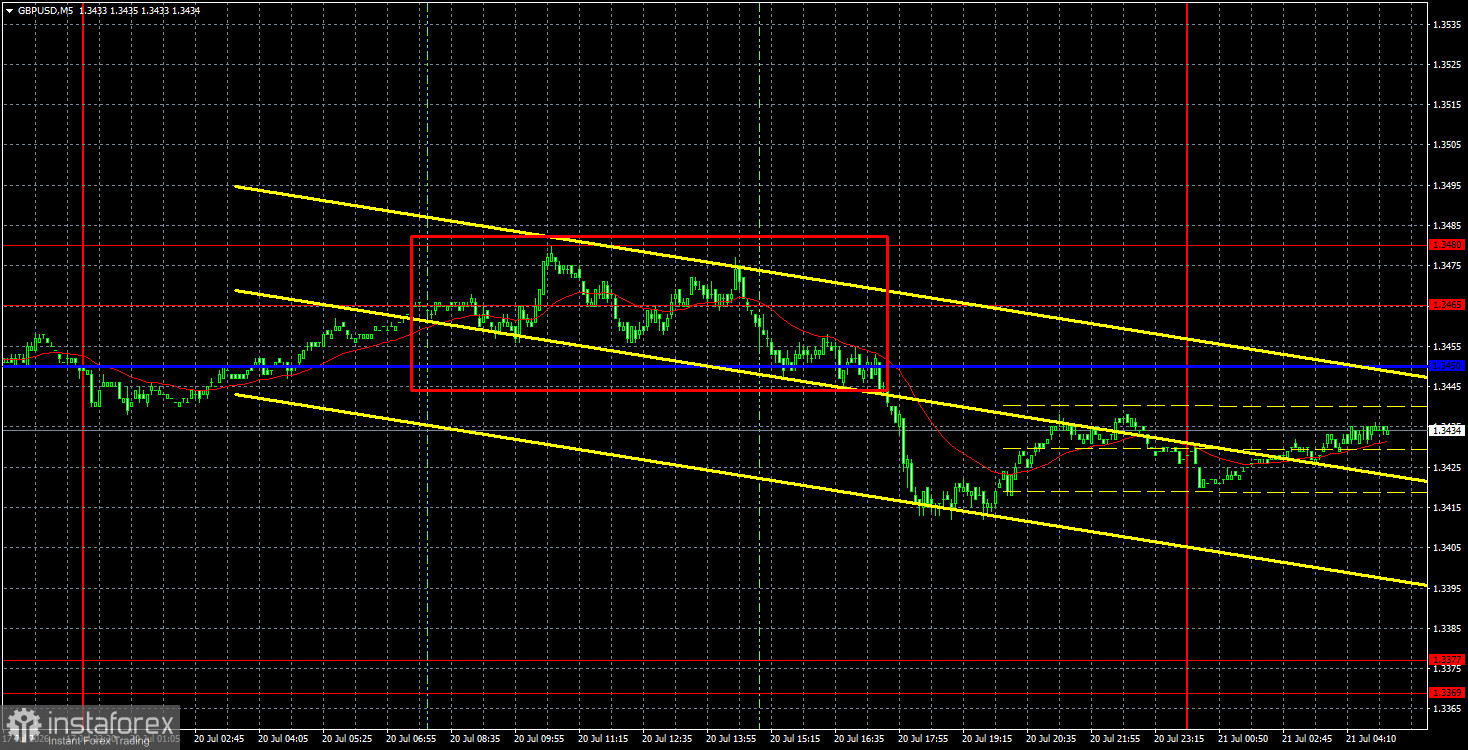
The GBP/USD currency pair continued its downward correction on Monday against the backdrop of a three-week rise. There were no local reasons for the pound to fall or the dollar to rise, which resulted in a purely technical movement. Recall that a flat pattern has persisted on the daily and weekly timeframes, so movement from the lower boundary of the sideways channel began towards the upper boundary. Therefore, after the current correction concludes, growth may be resumed. For now, the movement towards the area of 1.3369-1.3377 could continue. There were no significant macroeconomic or fundamental events on Monday in the U.S. or the UK. Geopolitics could have supported the U.S. dollar, but the currency can no longer rely on its previous support. We still do not see what could drive the dollar up in the medium term. At most, it will be a correction. Beyond that, everything will depend on developments in the Middle East, oil prices, inflation, and central bank policies.
From a technical standpoint, the British pound continues its upward trend. The price managed to overcome the area of 1.3465-1.3480 as well as the Kijun-sen line, which complicates things for the bulls a bit. Now, the British pound may continue its decline towards the area of 1.3369-1.3377 and the Senkou Span B line. A consolidation above the area of 1.3465-1.3480 could provoke a resumption of the upward trend of recent weeks.
On the 5-minute timeframe on Monday, a sell signal was formed. During the European trading session, the price bounced off the area of 1.3465-1.3480 and then crossed the critical line. After this, it moved down by 20 pips. Today, the decline of the British currency may continue, and a sell signal is already available, or a new one could be formed.
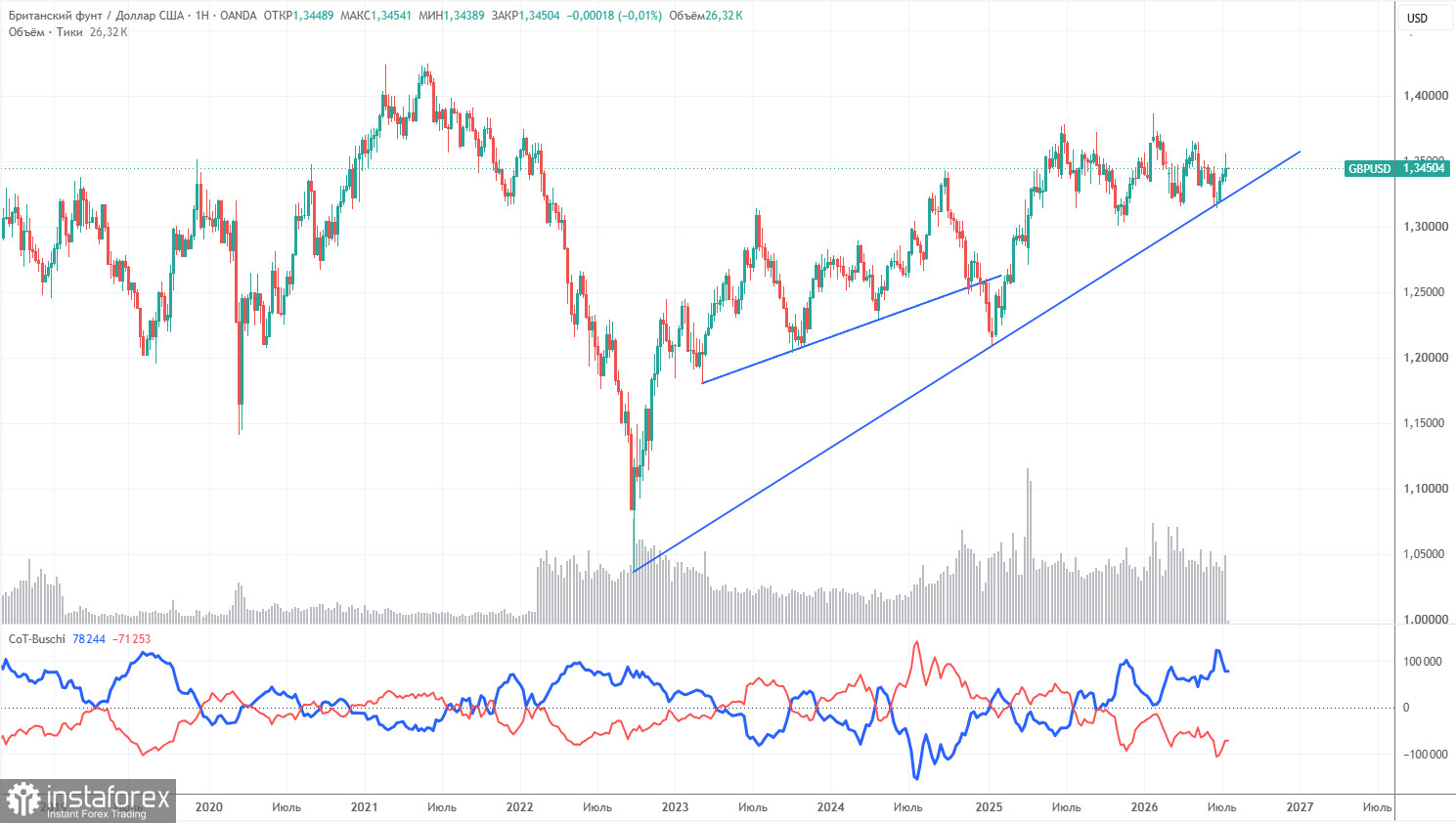
COT reports for the British pound show that non-commercial traders have dominated the market with sell positions for several months. The net position is negative, despite the long-term upward trend being maintained. Given the events in the Middle East, it is not surprising that demand for risk currencies remains weak. The war is formally over, but the conflict persists. Geopolitics could support demand for the U.S. dollar in the near future. However, we would not expect a strong decline in the pair until a consolidation below the trend line occurs.
In the long term, the dollar will continue to decline due to Donald Trump's policies, which is clearly visible on the weekly timeframe (illustration above). The trade war will continue in one form or another for a long time, and Trump's policies are aimed, both directly and indirectly, at weakening the American currency. The long-term upward trend remains intact, as evidenced by the trend line. The price recently tested this line and bounced off it. According to the latest COT report (as of July 14), the "Non-commercial" group opened 6,500 BUY contracts and closed 10,100 SELL contracts. Thus, the net position of non-commercial traders rose by 16,600 contracts over the week, which does not significantly affect the overall sentiment of professional players.
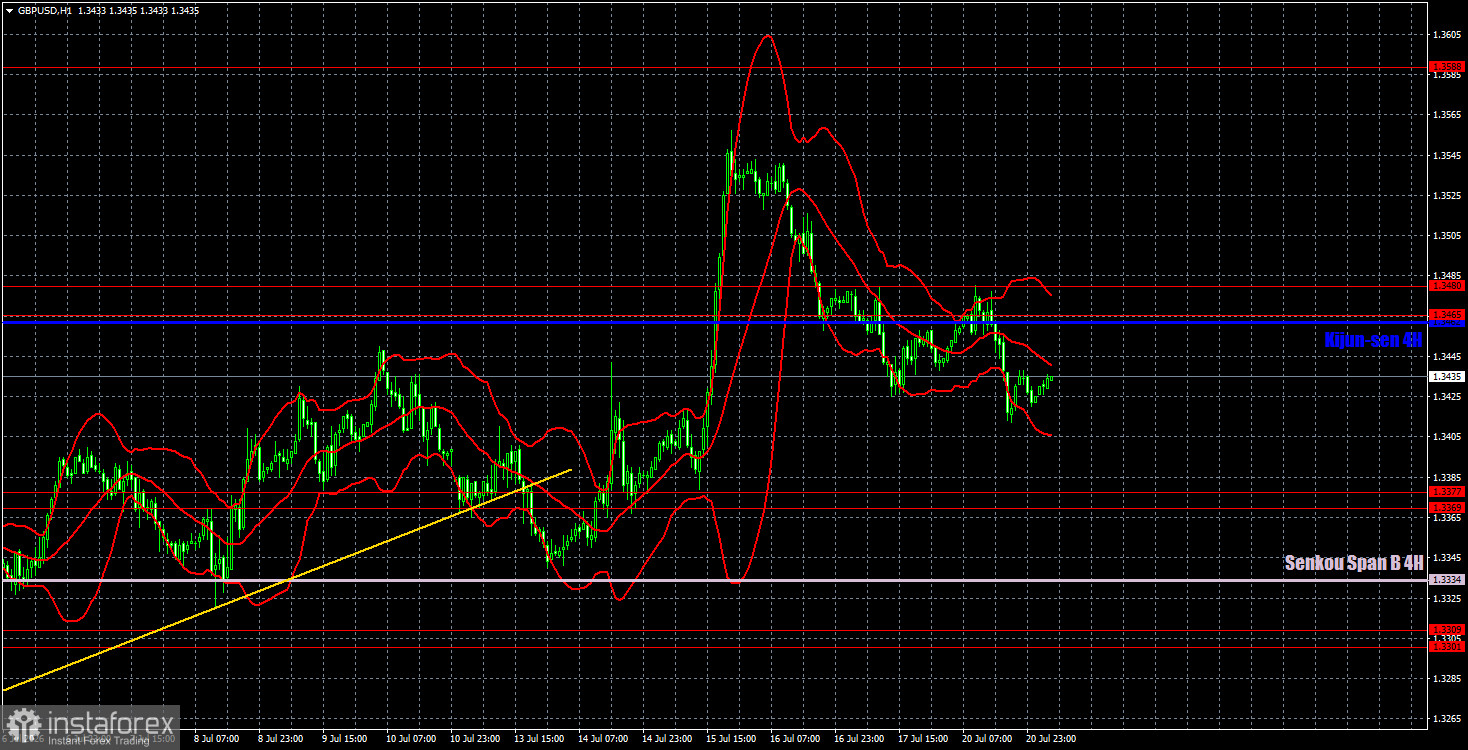
On the hourly timeframe, the GBP/USD pair continues to correct after three weeks of growth. The market continues to ignore geopolitics, and in recent weeks we have observed a technical rise supported by weak inflation data in the U.S. We would not be surprised if the British currency continues to strengthen, as on the daily timeframe it is heading towards the upper boundary of the sideways channel, which is located in the range of 1.3720-1.3800.
For July 21, we highlight the following important levels: 1.3042-1.3050, 1.3096-1.3115, 1.3179-1.3187, 1.3301-1.3309, 1.3369-1.3377, 1.3465-1.3480, 1.3588, 1.3671-1.3681. The Senkou Span B (1.3334) and Kijun-sen (1.3462) lines could also serve as sources of signals. It is recommended to set the Stop Loss level to break even as the price moves in the correct direction by 20 pips. The lines of the Ichimoku indicator may shift throughout the day, which should be considered when determining trading signals.
On Tuesday, the UK is scheduled to publish reports on unemployment, the number of unemployed, and wages. In the U.S., there will be a secondary ADP report for the week. The British data could provoke a market reaction, but it is likely to be weak. The market is now paying closer attention to inflation, the labor market, and monetary policy.
Today, traders may remain in short positions targeting the area of 1.3369-1.3377, as the pair bounced off the area of 1.3465-1.3480 yesterday. New long positions can be opened in case of consolidation above the area of 1.3465-1.3480 with a target of 1.3588.


