
See also


 15.05.2026 06:10 PM
The GBP/USD pair has been falling for the fourth consecutive day. The reasons behind the pound's decline are not difficult to identify, but I still believe that a loss of 250 points in less than four full days is excessive. I do not dispute that the political crisis in the United Kingdom is a factor. The possible escalation of war in the Middle East is also a factor. High inflation in the United States and stronger hawkish market expectations regarding Federal Reserve monetary policy are factors as well. However, the Fed has not yet given a single signal suggesting possible policy tightening. Rising inflation was expected by virtually all experts, and it is not limited to the United States. The Bank of England and the ECB are prepared to raise rates at their next meetings. Political crises in Britain over the past 10–15 years have become routine. There have been at least four possible escalations in the Middle East over just the last two weeks.
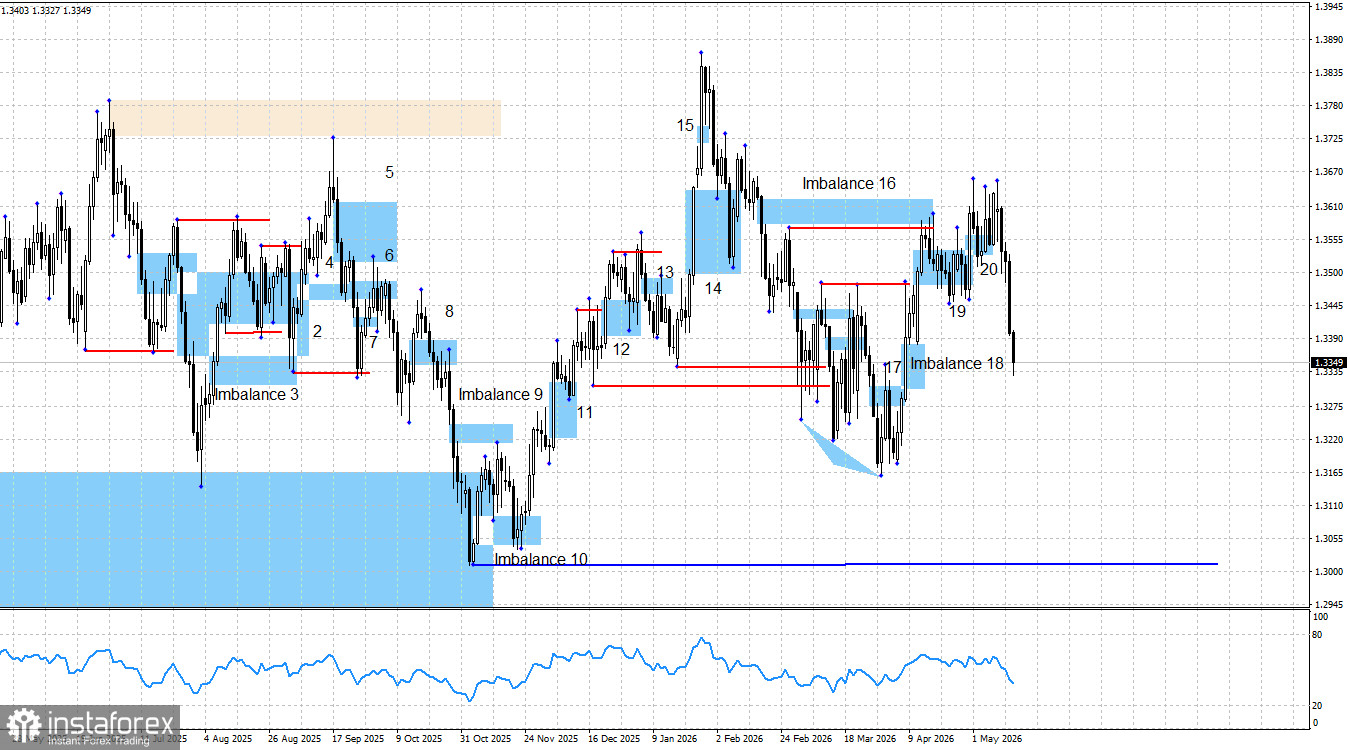
In my view, the market had been pricing in optimism regarding the Middle East conflict in recent weeks and is now pricing in pessimism because that optimism failed to materialize. Even so, I believe the pound's decline has been excessively sharp. The euro has now reached a bullish imbalance zone, while the British pound has reached bullish imbalance 18. This imbalance had already been tested previously, but there can be more than one reaction to the same pattern. At the moment, both the euro and the pound have reached support zones, so I expect a reaction from these levels and a renewed bullish advance. If the patterns are invalidated, it will become difficult to deny the bearish momentum.
The situation surrounding the resolution of the Middle East conflict has completely stalled, and traders do not understand which direction the pendulum will swing next. Today it may swing toward the bulls, tomorrow toward the bears. This is exactly the picture we have been observing in recent weeks. At the moment, belief in peace in the Middle East and in the lifting of the blockade of the Strait of Hormuz is gradually fading.
In my opinion, the overall trend remains bullish despite the pair's sharp declines this year. The ceasefire in the Middle East is currently fragile, but it still exists. Naturally, the market cannot rely forever on information that is not confirmed by facts. The Strait of Hormuz remains under a dual blockade, and although Tehran and Washington have been working toward lifting it for several weeks, there has been no result. The situation alternates between improving and deteriorating. The markets were very optimistic about a month ago, but now that optimism has been replaced by more objective conditions.
The current technical picture is as follows: bullish imbalance 18 remains in place and may trigger a reaction that revives the pound. If this pattern is invalidated, the decline may continue, and in that case we would begin talking about a full-fledged bearish trend. After this week's collapse, a bearish imbalance will form, allowing for short positions to be opened. However, for me, imbalance 18 remains the more important factor for now.
Friday's economic news background helped the bears push slightly lower, although their momentum is also fading. Industrial production volumes in April rose by 0.7% month-on-month and 1.4% year-on-year, both of which exceeded market expectations. However, the pound had already been falling since Thursday, so the production report was not the key driver behind the dollar's strength.
In the United States, the overall news backdrop remains such that, in the long term, nothing but a decline in the dollar should be expected. Even the conflict between Iran and the United States changes little. Geopolitics temporarily reminded the market of the dollar's safe-haven status for two months, but overall the long-term outlook for the U.S. dollar remains difficult. The U.S. labor market continues to weaken, the economy is approaching recession, and the Fed — unlike the ECB and the Bank of England — does not intend to tighten monetary policy in 2026. Across the United States, four major protest movements against Donald Trump have already taken place, and Jerome Powell's departure could only worsen the situation for the dollar if the FOMC under Kevin Warsh adopts a more dovish stance. From an economic perspective, I see no basis for dollar growth.
Economic calendar for the U.S. and the United Kingdom:
The economic calendar for May 18 contains no notable events. The economic backdrop will therefore have no influence on market sentiment on Monday. However, new geopolitical developments may emerge over the weekend.
GBP/USD forecast and trading advice:
For the pound, the long-term outlook remains bullish. The "Three Drives Pattern" warned traders about the beginning of growth, and since then three bullish patterns and three bullish signals have formed. This week, geopolitics damaged the bulls' previously optimistic outlook, but they still have a chance to retain the initiative through imbalance 18. My target for the pound remains the 2026 high at 1.3867. I will only begin considering a bearish trend if imbalance 18 is invalidated. In that case, bearish patterns will come into play.


