
See also


 06.03.2026 10:50 AM
During Thursday, the EUR/USD pair returned to the 100.0% corrective level at 1.1577 and once again rebounded from it. Thus, the euro's upward movement may continue toward the 76.4% corrective level at 1.1696. If the pair consolidates below 1.1577, further decline toward the 127.2% Fibonacci level at 1.1440 can be expected.
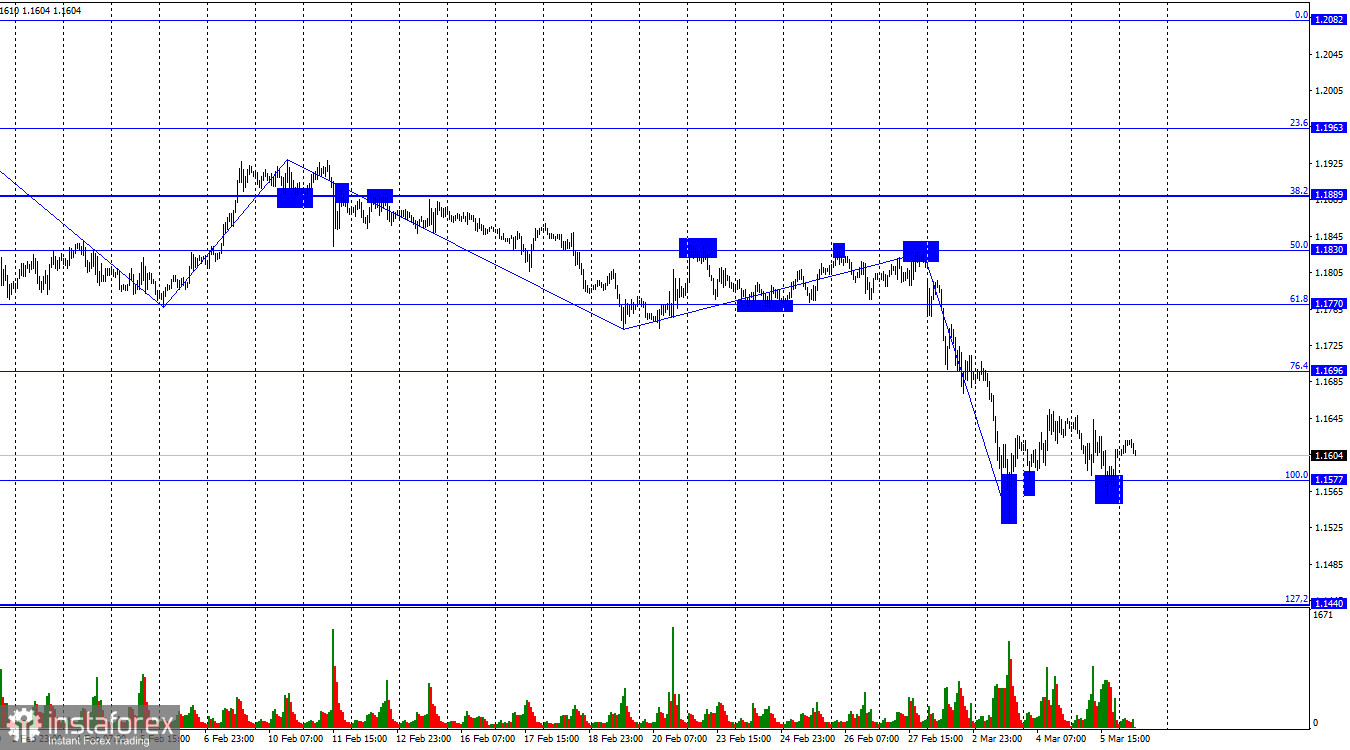
The wave situation on the hourly chart remains straightforward. The last completed upward wave failed to break the peak of the previous wave, while the new downward wave confidently broke the previous low. Therefore, the trend remains bearish. Bulls have taken a pause within what had been a large-scale advance that would not have been possible without Donald Trump. However, it is precisely the actions of Donald Trump in the Middle East, which provoked large-scale military operations involving about a dozen states, that are now working in favor of the U.S. currency.
On Thursday, the news background once again created problems for the euro. Recently, the euro has been under strong market pressure, as demand for the safe-haven dollar is rising rapidly due to the war in the Middle East and the consequences already felt by the global economy. In addition, retail trade in the European Union fell by 0.1% in January, although traders had expected growth of 0.3–0.5% month-on-month. In annual terms, volumes increased by 2%, which exceeded forecasts, but the monthly indicator is considered more important. As a result, the European currency failed to stage a meaningful recovery and retreated again.
The situation in the Middle East continues to escalate. More and more countries are beginning to see Iran as a real threat to their security and are therefore willing to join the American coalition. Yesterday it became known that the United Kingdom and Spain are ready to enter the war. Of course, not on a full scale, since such escalation is not particularly desired in Europe. But London and Madrid are prepared to send a couple of warships to the region or around a hundred troops. This is unlikely to change the balance of power on the battlefield—especially since there is effectively no traditional battlefield.
The deterioration of the situation in the European region is also restraining the euro's growth. Northern countries are developing evacuation plans in case of war. The energy crisis, which will hit the Eurozone the hardest, also adds to the pessimism.
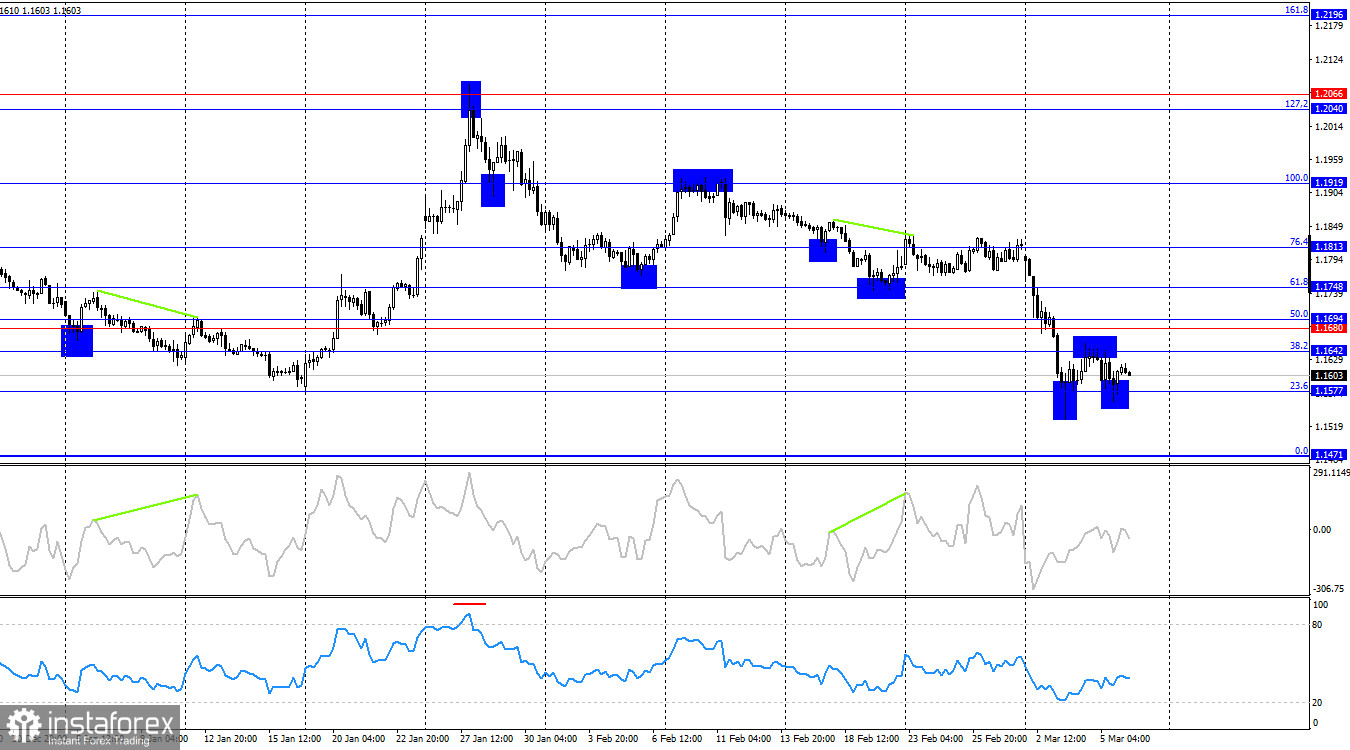
On the 4-hour chart, the pair returned to the 38.2% corrective level at 1.1642, rebounded, and moved back toward the 23.6% Fibonacci level at 1.1577. A rebound from this level would allow traders to expect another rise toward 1.1642. A consolidation below 1.1577 would increase the likelihood of further euro decline toward the next correction level 0.0% at 1.1471. No emerging divergences are currently observed on any indicators.
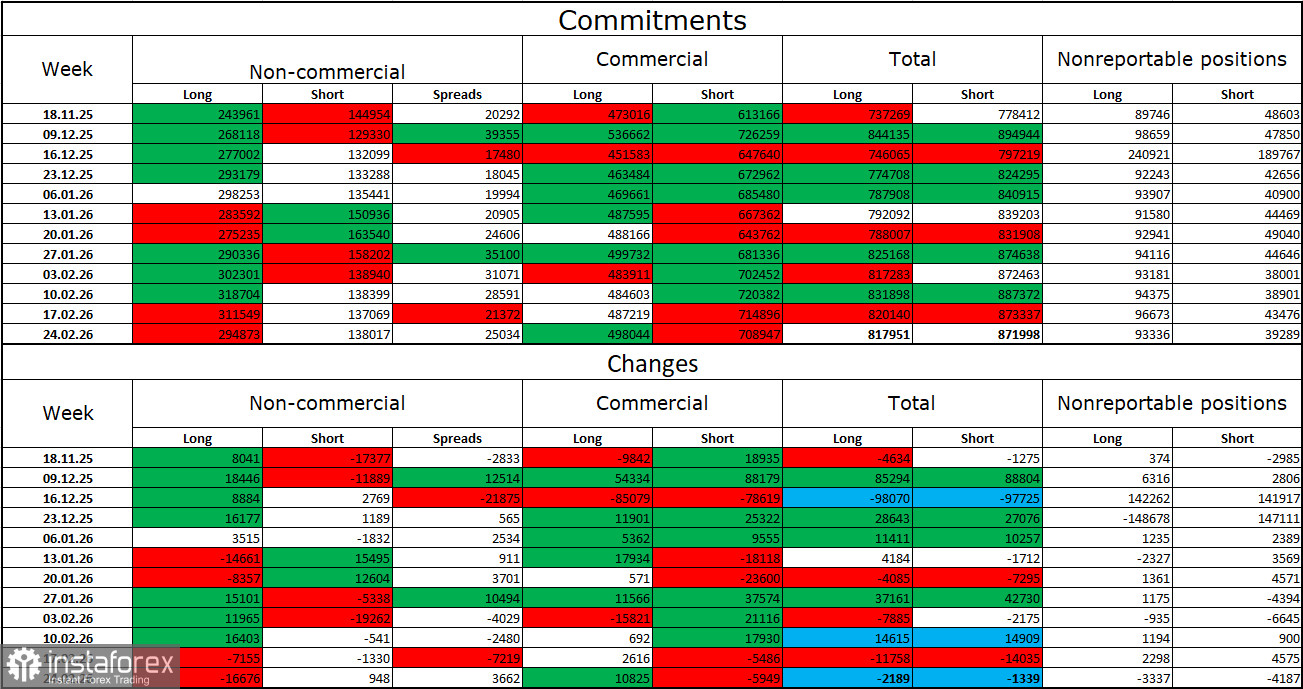
During the latest reporting week, professional traders closed 16,676 long positions and opened 948 short positions. The sentiment of the Non-commercial group remains bullish, largely due to Donald Trump and his policies, although in recent weeks we have seen a reduction in long positions. The total number of long positions held by speculators now stands at 294,000, while short positions amount to 138,000. Bulls still maintain more than a twofold advantage.
Overall, in the long term, large players continue to reduce short positions and increase long ones. Of course, global events—of which there has been no shortage in recent years—affect investor behavior in various ways. At present, market attention is focused on the Middle East, where the war continues to intensify and expand geographically. Therefore, in the near future, the euro–dollar exchange rate will depend not on Donald Trump's policies, but on the war involving Iran.
European Union
United States
On March 6, the economic calendar contains at least three notable and important entries. This time, the economy may turn out to be more important than geopolitics. The news background will influence market sentiment on Friday, especially in the second half of the day.
Selling positions were possible after a rebound from 1.1830 on the hourly chart with targets at 1.1770, 1.1696, and 1.1577. All targets have been reached. Today, sell trades can be opened if the pair closes below 1.1577, targeting 1.1440. Buy trades can be considered if the price rebounds from 1.1577, with a target of 1.1696.
Fibonacci grids are built from 1.1805–1.1578 on the hourly chart and 1.1919–1.1471 on the 4-hour chart.


