
See also


 22.12.2025 09:18 PM
The wave count on the 4-hour chart for EUR/USD has a fairly clear, though rather complex, structure. There is no talk of canceling the upward trend segment that began in January 2025, but the wave structure starting from July 1 has taken on a complex and extended form. In my view, the pair has completed the formation of corrective wave 4, which took on a very non-standard shape. Within this wave, we observed exclusively corrective structures, so there is no doubt about the corrective nature of the decline.
In my opinion, the formation of the upward trend segment is not complete, and its targets may extend as far as the 25th level. The a–b–c–d–e wave sequence looks complete; therefore, in the coming weeks I expect the formation of a new upward wave set. We have seen the presumed waves 1 and 2, and now the instrument is in the process of forming wave 3 or C. I expected that within this wave the instrument would rise to the 1.1717 level, which corresponds to the 38.2% Fibonacci level, but this wave is taking on a more extended form, which is very positive, as it may become impulsive. Along with it, the entire upward wave sequence could also turn out to be impulsive.
The EUR/USD pair rose by 50 basis points during Monday, and many economists have already started to panic. Their view is as follows: the market is currently "thin," EUR/USD has been moving sideways for six months, and therefore the New Year and Christmas holidays are a good time to break out of the cursed range. In my opinion, it is too early to sound the alarm. The instrument gained only about 50 points, yet the market has already buried the dollar. Let me remind you that although I myself expect further weakening of the U.S. currency, holidays very rarely pass with active trading. Therefore, the euro's strengthening on Monday amid a complete absence of news is more likely a coincidence.
If we speak about the long term, however, I fully support the idea of a weaker dollar, and many analysts share this view. The dollar has nothing to hold on to, as the Fed will continue easing monetary policy in 2026. After Jerome Powell steps down, the interest rate could fall much lower than the level that allows the regulator to control inflation. Donald Trump does not care what inflation will be in the U.S., and the latest November report also showed that the devil is not as bad as he is painted. Inflation is declining, and the trade war has not led to a significant acceleration in prices. Consequently, the FOMC will continue policy easing against the backdrop of the ongoing crisis in the U.S. labor market. Since the formation of an upward wave set began a month ago, I expect it to continue.
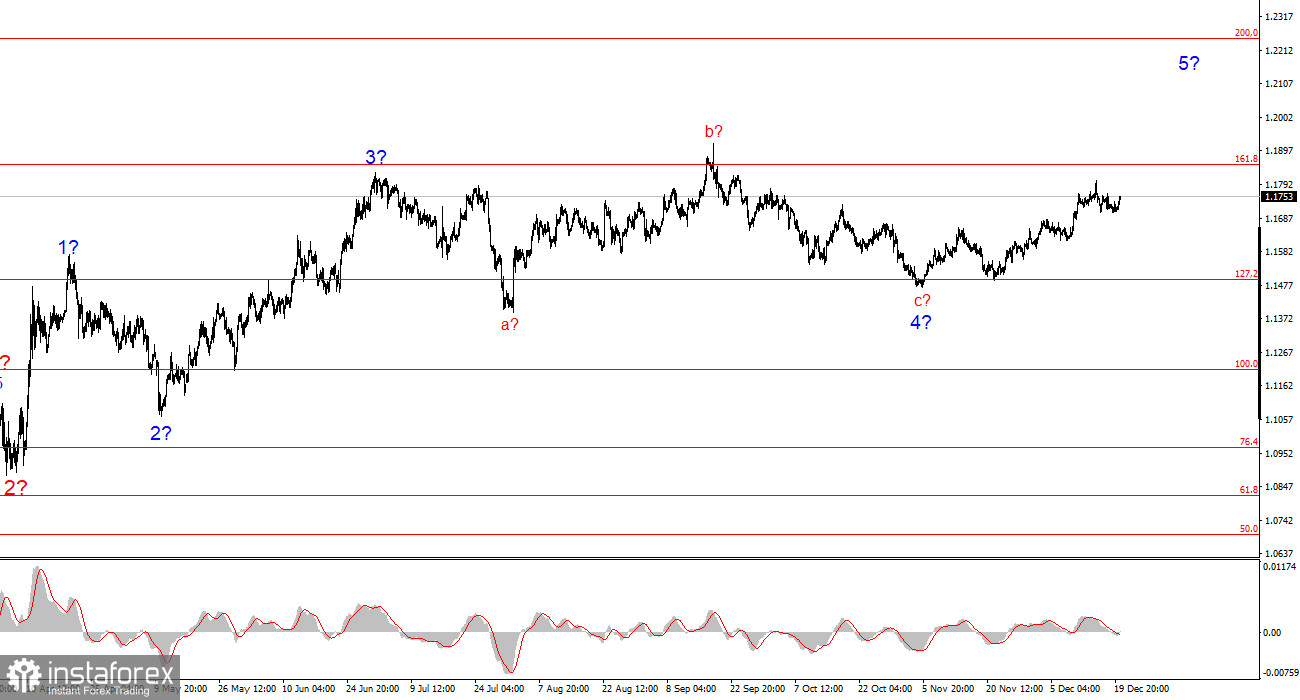
Based on the EUR/USD analysis conducted, I conclude that the instrument continues to form an upward trend segment. Donald Trump's policies and the Fed's monetary policy remain significant factors behind the long-term weakening of the U.S. dollar. The targets of the current trend segment may extend as far as the 25th figure. The current upward wave set is beginning to gain momentum, and one would like to believe that we are now witnessing the formation of an impulsive wave set that is part of the global wave 5. In this case, growth should be expected with targets near 1.1825 and 1.1926, which correspond to the 200.0% and 261.8% Fibonacci levels.
On a smaller scale, the entire upward trend segment is visible. The wave count is not the most standard, as corrective waves have different sizes. For example, the higher-degree wave 2 is smaller in size than the internal wave 2 within wave 3. However, this also happens. Let me remind you that it is best to identify clear and understandable structures on charts rather than rigidly trying to label every single wave. At the moment, the upward structure raises no doubts.
Core Principles of My Analysis:


