
See also


 23.12.2025 12:55 AM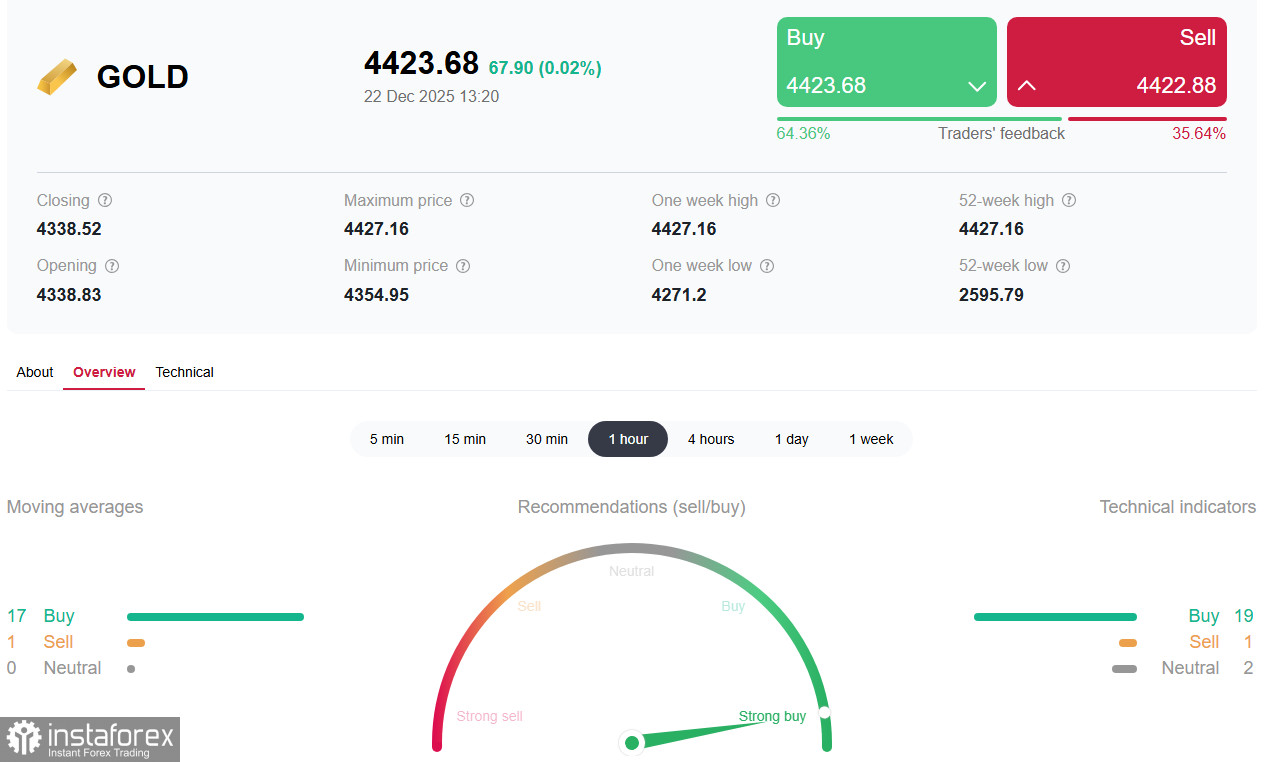
*) see also: InstaTrade Trading Indicators for XAU/USD
Gold prices surged at the opening of Monday's trading session, reaching a new historical high near $4,420.00 per ounce at the beginning of the European trading session.
This significant increase is the result of a complex set of factors, including geopolitical tensions and the expected decisions from the Federal Reserve regarding future monetary policy.
As the U.S. trading session began, prices stabilized slightly around $4,410.00. Nevertheless, a strong bullish momentum persists, pushing quotes into uncharted territory and towards new historical highs.
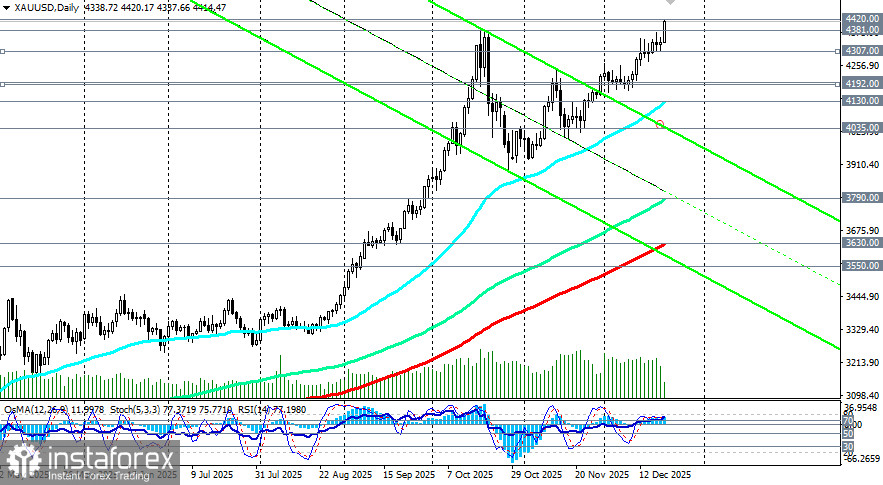
Gold prices have shown a steady upward trend since the fourth quarter of 2022, and this growth has accelerated significantly since the first quarter of 2024. There has been a series of record values: after surpassing the $1,000.00 per ounce mark in 2008 and $2,000.00 during the pandemic, quotes soared above $3,000.00, reaching a historical peak of $3,500.00 per ounce on April 22, 2025, and $4,380.00 in October of the current year. A sharp correction followed. However, the support zone around $3,940.00 (EMA200 on the 4-hour chart at that time) held firm, and the price gradually began to rise again.
Corrections along the path to the rally have been encountered previously, sometimes sharply, but these have proven short-lived and have not altered the fundamental upward dynamics.
Specific fundamental factors are driving this growth: the escalation of geopolitical and trade risks, overall economic uncertainty, concerns about excessive government spending, and virtually unprecedented demand from central banks. An additional push came from a weakening dollar and changes in the U.S. Federal Reserve's monetary policy. The activity of central banks, in particular, has likely become a key driver of the current rally.
Meanwhile, geopolitical tensions have reached levels not seen since the Cold War. This fuels demand from both retail investors and institutional hedgers.
Some analysts in the precious metals market warn of the possibility of minor profit-taking before a new growth phase. We are observing not just a temporary surge, but the formation of a new architecture for global reserves, in which gold is reclaiming its fundamental role. Therefore, even if corrections occur, the logic of the long-term trend remains on the side of gold.
As geopolitical and economic uncertainties remain the "new normal," gold will retain its status as a universal hedging tool and store of capital.
Gold is becoming the primary investment choice for those seeking capital protection amid uncertainty. Upcoming events, such as the outcomes of peace and trade negotiations and Federal Reserve meetings, will determine market trends. However, high geopolitical risks and the Fed's dovish stance make gold investments an attractive option.


